
The authors have designated this AOP as all rights reserved. Re-use in any form requires advanced permission from the authors.
AOP: 585
Title
AKT Inhibition blocks the autophagy flow through the PRKAA/AMPK pathway and leads to cardiotoxicity
Short name
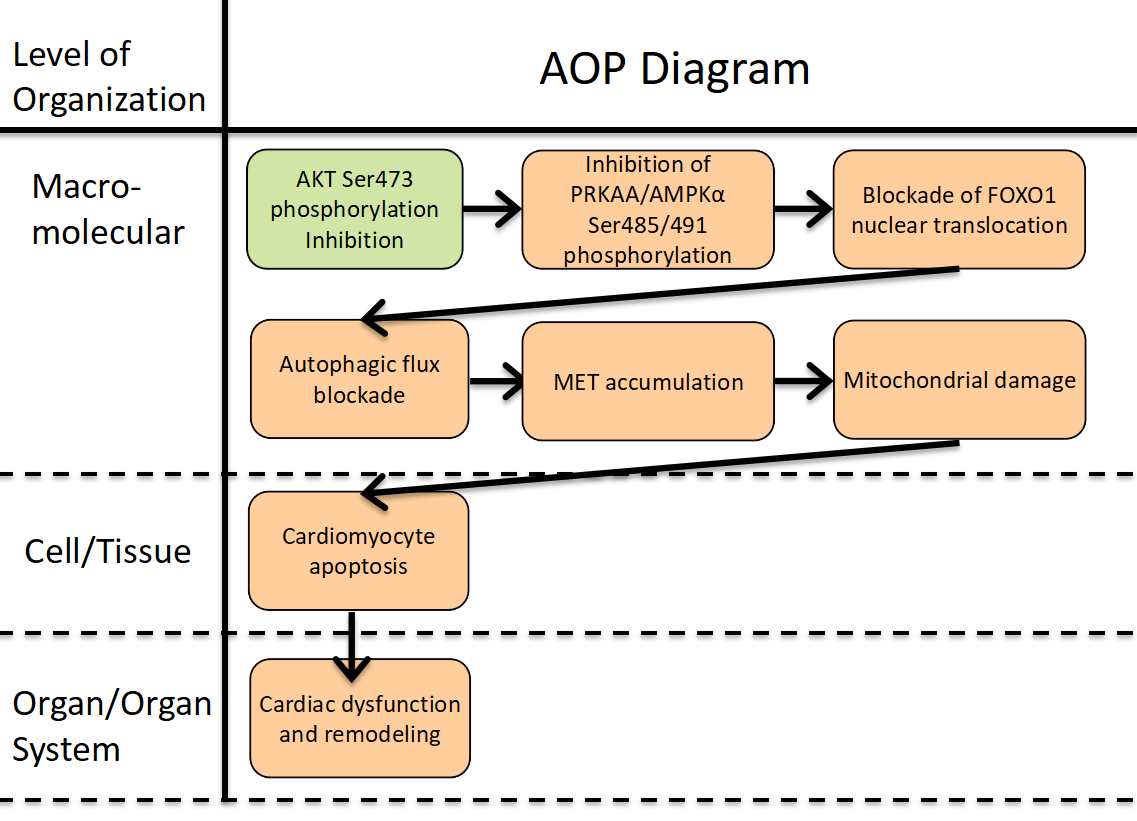
Graphical Representation
Additional AOP Exploration Options
Click links below to explore AOP 585, AKT Inhibition blocks the autophagy flow through the PRKAA/AMPK pathway and leads to cardiotoxicity in tools offered by third parties.

Point of Contact
Contributors
- Peihua Luo
Coaches
OECD Information Table
| OECD Project # | OECD Status | Reviewer's Reports | Journal-format Article | OECD iLibrary Published Version |
|---|---|---|---|---|
This AOP was last modified on July 15, 2025 03:53
Revision dates for related pages
| Page | Revision Date/Time |
|---|
Abstract
Cardiotoxicity refers to direct or indirect myocardial damage induced by pharmacological agents, resulting in structural and functional impairment. Manifestations range from subclinical dysfunction to cardiomyocyte loss, fibrotic replacement, and ultrastructural damage. Proposed mechanisms include ionic homeostasis imbalance, oxidative stress, mitochondrial damage, metabolic disturbances, and dysregulation of molecular targets. Nevertheless, key regulatory factors remain undefined.
Multi-target receptor tyrosine kinase inhibitors (MTTKIs) represent first-line therapies for various malignancies. However, cardiotoxicity constitutes a prevalent and severe adverse effect, often irreversible and limiting clinical utility. For instance, Crizotinib treatment associates with severe cardiac toxicity, including heart failure, contributing to poor prognosis and mortality in approximately 25% of affected patients.
Drawing from previous research, a specific adverse outcome pathway (AOP) has been identified, potentially mediated by AKT Ser473 phosphorylation Inhibition, likely offering insights into specific molecular mechanisms contributing to cardiac toxicity. In this AOP, the Molecular Initiating Event (MIE) is "AKT Ser473 phosphorylation Inhibition," triggering six Key Events (KEs): " Inhibition of PRKAA/AMPKα Ser485/491 phosphorylation ," "Blockade of FOXO1 nuclear translocation," "Autophagic flux blockade," "MET accumulation," "Mitochondrial damage," and "Cardiomyocyte apoptosis." Ultimately, this pathway culminates in the Adverse Outcome (AO) of Cardiac dysfunction and remodeling.
AOP Development Strategy
Context
Strategy
Summary of the AOP
Events:
Molecular Initiating Events (MIE)
Key Events (KE)
Adverse Outcomes (AO)
Relationships Between Two Key Events (Including MIEs and AOs)
Network View
Prototypical Stressors
Life Stage Applicability
Taxonomic Applicability
Sex Applicability
Overall Assessment of the AOP
Domain of Applicability
Essentiality of the Key Events
Evidence Assessment
Known Modulating Factors
| Modulating Factor (MF) | Influence or Outcome | KER(s) involved |
|---|---|---|
Quantitative Understanding
Considerations for Potential Applications of the AOP (optional)
References
- Xu Z, Pan Z, Jin Y, Gao Z, Jiang F, Fu H, Chen X, Zhang X, Yan H, Yang X, Yang B, He Q, Luo P. Inhibition of PRKAA/AMPK (Ser485/491) phosphorylation by crizotinib induces cardiotoxicity via perturbing autophagosome-lysosome fusion. Autophagy. 2024 Feb;20(2):416-436.
- Lindeman NI, Cagle PT, Aisner DL, et al. Updated Molecular Testing Guideline for the Selection of Lung Cancer Patients for Treatment With Targeted Tyrosine Kinase Inhibitors: Guideline From the College of American Pathologists, the International Association for the Study of Lung Cancer, and the Association for Molecular Pathology. J Thorac Oncol. 2018 Mar;13(3):323-358.
- Liu Y, Chen C, Rong C, et al. Anaplastic Lymphoma kinase tyrosine kinase inhibitor-associated cardiotoxicity: a recent five-year pharmacovigilance study. Front Pharmacol. 2022; 13:858279.
- Ma X, Liu H, Foyil SR, et al. Impaired autophagosome clearance contributes to cardiomyocyte death in ischemia/reperfusion injury. Circulation. 2012 Jun 26;125(25):3170–3181.
- Wang B, Nie J, Wu L, et al. AMPKalpha2 protects against the development of heart failure by enhancing mitophagy via PINK1 phosphorylation. Circ Res. 2018 Mar 2;122(5):712–729.
- Jang M, Park R, Kim H, et al. AMPK contributes to autophagosome maturation and lysosomal fusion. Sci Rep. 2018 Aug 23;8 (1):12637.