
The authors have designated this AOP as all rights reserved. Re-use in any form requires advanced permission from the authors.
AOP: 586
Title
The increasing accumulation of HMGB1 in the nucleus causes cardiomyocyte death via HMGB1/HSPB1/CCN2 pathway
Short name
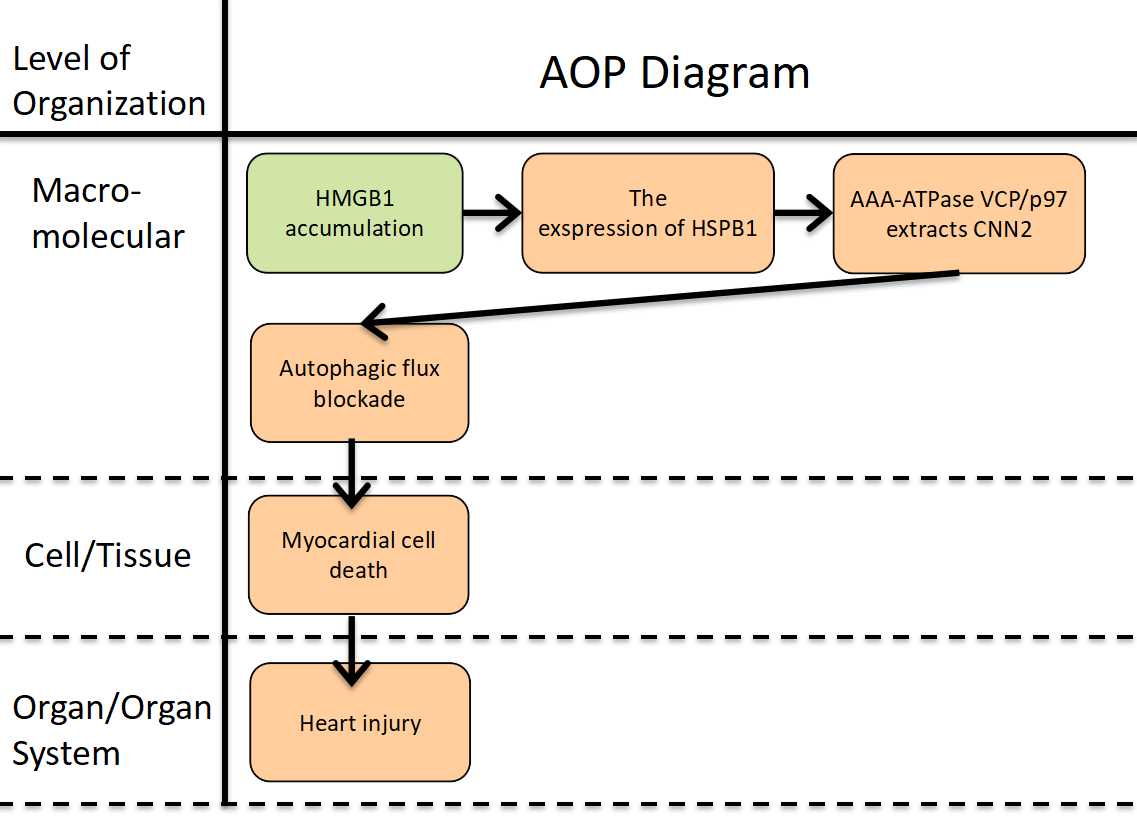
Graphical Representation
Additional AOP Exploration Options
Click links below to explore AOP 586, The increasing accumulation of HMGB1 in the nucleus causes cardiomyocyte death via HMGB1/HSPB1/CCN2 pathway in tools offered by third parties.

Point of Contact
Contributors
- Peihua Luo
Coaches
OECD Information Table
| OECD Project # | OECD Status | Reviewer's Reports | Journal-format Article | OECD iLibrary Published Version |
|---|---|---|---|---|
This AOP was last modified on July 10, 2025 01:58
Revision dates for related pages
| Page | Revision Date/Time |
|---|
Abstract
Cardiotoxicity denotes drug-induced structural and functional cardiac impairment, encompassing subclinical abnormalities, cardiomyocyte depletion, fibrotic remodeling, and ultrastructural alterations. Established mechanisms involve ionic channel dysregulation, reactive oxygen species (ROS)-mediated oxidative stress, mitochondrial dysfunction, metabolic disturbances, and epigenetic modulation. However, upstream regulatory determinants remain elusive.
Multi-target receptor tyrosine kinase inhibitors (MTTKIs) demonstrate therapeutic efficacy against diverse cancers but induce frequent and severe cardiotoxicity. This adverse effect exhibits high clinical incidence and irreversibility, substantially limiting drug utility. For example, sunitinib therapy associates with left ventricular ejection fraction reduction in 20% of patients and congestive heart failure in 8%, imposing significant cardiovascular burden.
A specific adverse outcome pathway (AOP) has been characterized, mediated by High Mobility Group Box 1 Protein (HMGB1), providing mechanistic insights into cardiotoxicity. In this AOP, the Molecular Initiating Event (MIE) is "HMGB1 accumulation," triggering four Key Events (KEs): " The expression of HSPB1," "AAA-ATPase VCP/p97 extracts CNN2," "Autophagic flux blockade," and "Myocardial cell death." Ultimately, this pathway culminates in the Adverse Outcome (AO) of Heart injury.
AOP Development Strategy
Context
Strategy
Summary of the AOP
Events:
Molecular Initiating Events (MIE)
Key Events (KE)
Adverse Outcomes (AO)
Relationships Between Two Key Events (Including MIEs and AOs)
Network View
Prototypical Stressors
Life Stage Applicability
Taxonomic Applicability
Sex Applicability
Overall Assessment of the AOP
Domain of Applicability
Essentiality of the Key Events
Evidence Assessment
Known Modulating Factors
| Modulating Factor (MF) | Influence or Outcome | KER(s) involved |
|---|---|---|
Quantitative Understanding
Considerations for Potential Applications of the AOP (optional)
References
- Xu Z, Jin Y, Gao Z, Zeng Y, Du J, Yan H, Chen X, Ping L, Lin N, Yang B, He Q, Luo P. Autophagic degradation of CCN2 (cellular communication network factor 2) causes cardiotoxicity of sunitinib. Autophagy. 2022 May;18(5):1152-1173.
- Del Re DP, Amgalan D, Linkermann A, et al. Fundamental mechanisms of regulated cell death and implications for heart disease. Physiol Rev. 2019;99:1763–1817.
- Jin Y, Xu ZF, Yan H, et al. A Comprehensive Review of Clinical Cardiotoxicity Incidence of FDA-Approved Small-Molecule Kinase Inhibitors. Front Pharmacol. 2020; 11:891.
- Raymond E, Dahan L, Raoul JL, et al. Sunitinib malate for the treatment of pancreatic neuroendocrine tumors. New Engl J Med. 2011; 364:501–513.
- Chu TF, Rupnick MA, Kerkela R, et al. Cardiotoxicity associated with tyrosine kinase inhibitor sunitinib. Lancet. 2007; 370:2011–2019.
- Luo PH, Xu ZF, Li GQ, et al. HMGB1 represses the anti-cancer activity of sunitinib by governing TP53 autophagic degradation via its nucleus-to-cytoplasm transport. Autophagy. 2018;14 (12):2155–2170.
- Kang R, Livesey KM, Zeh HJ, et al. Metabolic regulation by HMGB1-mediated autophagy and mitophagy. Autophagy. 2011; 7:1256–1258.