
This AOP is licensed under the BY-SA license. This license allows reusers to distribute, remix, adapt, and build upon the material in any medium or format, so long as attribution is given to the creator. The license allows for commercial use. If you remix, adapt, or build upon the material, you must license the modified material under identical terms.
AOP: 592
Title
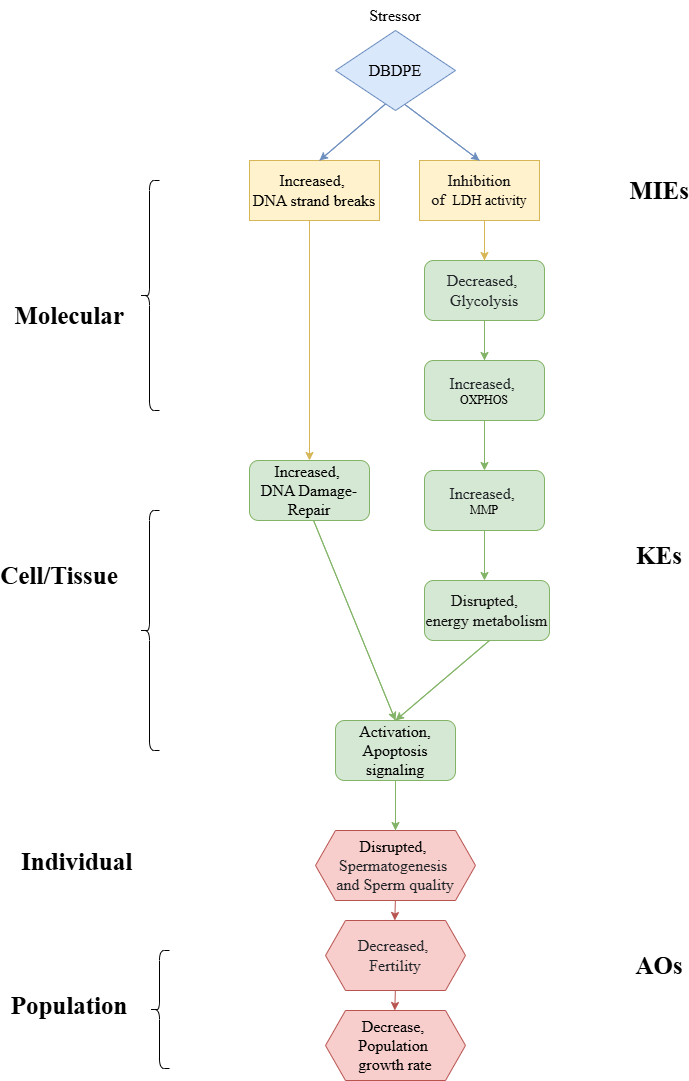
DBDPE-induced DNA strand breaks and LDH activity inhibition leading to population growth rate decline via energy metabolism disrupt and apoptosis
Short name
Graphical Representation
Additional AOP Exploration Options
Click links below to explore AOP 592, DBDPE-induced DNA strand breaks and LDH activity inhibition leading to population growth rate decline via energy metabolism disrupt and apoptosis in tools offered by third parties.

Point of Contact
Contributors
- lihua Yang
Coaches
OECD Information Table
| OECD Project # | OECD Status | Reviewer's Reports | Journal-format Article | OECD iLibrary Published Version |
|---|---|---|---|---|
This AOP was last modified on October 23, 2025 04:44
Revision dates for related pages
| Page | Revision Date/Time |
|---|---|
| Increase, DNA strand breaks | September 02, 2026 04:21 |
| Inhibition of LDH activity | August 16, 2025 00:33 |
| Increased, DNA Damage-Repair | September 16, 2017 10:17 |
| Decreased, Glycolysis | August 16, 2025 00:33 |
| Increased, OXPHOS | August 16, 2025 00:34 |
| Increased, MMP | August 16, 2025 00:34 |
| Disrupted, energy metabolism | August 16, 2025 00:35 |
| Activation, Apoptosis signaling | August 16, 2025 00:35 |
| Disrupted, Spermatogenesis and Sperm quality | August 16, 2025 00:36 |
| decreased, Fertility | December 17, 2024 15:46 |
| Decrease, Population growth rate | January 03, 2023 09:09 |
| Increase, DNA strand breaks leads to Increased, DNA Damage-Repair | August 16, 2025 00:37 |
| Increased, DNA Damage-Repair leads to Activation, Apoptosis signaling | August 16, 2025 00:37 |
| Inhibition of LDH activity leads to Decreased, Glycolysis | August 16, 2025 00:38 |
| Decreased, Glycolysis leads to Increased, OXPHOS | August 16, 2025 00:38 |
| Increased, OXPHOS leads to Increased, MMP | August 16, 2025 00:38 |
| Increased, MMP leads to Disrupted, energy metabolism | August 16, 2025 00:38 |
| Disrupted, energy metabolism leads to Activation, Apoptosis signaling | August 16, 2025 00:38 |
| Activation, Apoptosis signaling leads to Disrupted, Spermatogenesis and Sperm quality | August 16, 2025 00:39 |
| Disrupted, Spermatogenesis and Sperm quality leads to decreased, Fertility | August 16, 2025 00:39 |
| decreased, Fertility leads to Decrease, Population growth rate | March 26, 2021 15:24 |
| 1,1'-Ethane-1,2-diylbis(pentabromobenzene) | December 29, 2024 21:12 |
Abstract
This Adverse Outcome Pathway (AOP) delineates the male reproductive toxicity of decabromodiphenyl ethane (DBDPE), a widely used novel brominated flame retardant (NBFR), integrating evidence from ex vivo zebrafish spermatozoa, in vivo zebrafish models, and in vitro mouse spermatogonial (GC-1) cell studies. The AOP development addresses growing concerns over DBDPE’s environmental persistence, bioaccumulation potential, and reproductive risks, particularly given its role as a replacement for legacy BFRs with poorly characterized hazards.
The pathway initiates with two Molecular Initiating Events: 1. Increased DNA strand breaks, triggered by DBDPE-induced genotoxic stress. 2. Inhibition of lactate dehydrogenase (LDH) activity, disrupting glycolytic flux. These MIEs propagate through critical Key Events : DNA damage response activation, leading to disrupted cell cycle regulation and apoptotic signaling. Metabolic reprogramming, characterized by decreased glycolysis and increased oxidative phosphorylation (OXPHOS), Cumulative energy metabolism disruption impairs spermatogenesis and sperm quality. The cascade culminates in Adverse Outcomes: Disrupted spermatogenesis and sperm quality (reduced motility, abnormal morphology). Decreased fertility and impaired population growth in aquatic species.
Scientific evidence from integrated omics , biochemical assays, and phenotypic analyses robustly supports the AOP. DNA damage, metabolic shifts, and germ cell apoptosis were consistently observed across models at environmentally relevant concentrations. Key knowledge gaps include species extrapolation to mammals, long-term multigenerational effects, and the exact role of nuclear actin polymerization in DNA damage.
This AOP provides a mechanistic framework for screening DBDPE-like compounds and supports the development of New Approach Methodologies (NAMs) combining in vitro, ex vivo, and non-rodent models for efficient risk assessment. Its application can inform regulatory policies on NBFRs and guide biomonitoring strategies for early detection of mitochondrial hyperpolarization (MMP) as a sensitive biomarker of metabolic disruption.
AOP Development Strategy
Context
This study is applicable for assessing the toxic effects of DBDPE at environmentally relevant concentrations on the reproductive systems of adult male zebrafish and mammals (mouse spermatogonial cells), particularly suitable for toxicity studies at the level of adult males and germ cells.
Strategy
Summary of the AOP
Events:
Molecular Initiating Events (MIE)
Key Events (KE)
Adverse Outcomes (AO)
| Type | Event ID | Title | Short name |
|---|
| MIE | 1635 | Increase, DNA strand breaks | Increase, DNA strand breaks |
| MIE | 2349 | Inhibition of LDH activity | Inhibition of LDH activity |
| KE | 1281 | Increased, DNA Damage-Repair | Increased, DNA Damage-Repair |
| KE | 2350 | Decreased, Glycolysis | Decreased, Glycolysis |
| KE | 2351 | Increased, OXPHOS | Increased, OXPHOS |
| KE | 2352 | Increased, MMP | Increased, MMP |
| KE | 2353 | Disrupted, energy metabolism | Disrupted, energy metabolism |
| KE | 2354 | Activation, Apoptosis signaling | Activation, Apoptosis signaling |
| AO | 2355 | Disrupted, Spermatogenesis and Sperm quality | Disrupted, Spermatogenesis and Sperm quality |
| AO | 406 | decreased, Fertility | decreased, Fertility |
| AO | 360 | Decrease, Population growth rate | Decrease, Population growth rate |
Relationships Between Two Key Events (Including MIEs and AOs)
| Title | Adjacency | Evidence | Quantitative Understanding |
|---|
| Increase, DNA strand breaks leads to Increased, DNA Damage-Repair | adjacent | High | High |
| Increased, DNA Damage-Repair leads to Activation, Apoptosis signaling | adjacent | High | High |
| Inhibition of LDH activity leads to Decreased, Glycolysis | adjacent | High | High |
| Decreased, Glycolysis leads to Increased, OXPHOS | adjacent | High | High |
| Increased, OXPHOS leads to Increased, MMP | adjacent | High | High |
| Increased, MMP leads to Disrupted, energy metabolism | adjacent | High | High |
| Disrupted, energy metabolism leads to Activation, Apoptosis signaling | adjacent | Moderate | Moderate |
| Activation, Apoptosis signaling leads to Disrupted, Spermatogenesis and Sperm quality | adjacent | High | High |
| Disrupted, Spermatogenesis and Sperm quality leads to decreased, Fertility | adjacent | High | High |
| decreased, Fertility leads to Decrease, Population growth rate | adjacent | High | High |
Network View
Prototypical Stressors
Life Stage Applicability
| Life stage | Evidence |
|---|---|
| Adults | High |
Taxonomic Applicability
| Term | Scientific Term | Evidence | Link |
|---|---|---|---|
| zebrafish | Danio rerio | High | NCBI |
Sex Applicability
| Sex | Evidence |
|---|---|
| Male | High |
Overall Assessment of the AOP
Domain of Applicability
Essentiality of the Key Events
In zebrafish testes and GC-1 cells, DBDPE-induced DNA damage is accompanied by abnormal spermatogenesis and activation of cell death signals; similarly, when using oxidative phosphorylation inhibitors (such as oxamate) to mimic the effects of DBDPE, DNA damage and metabolic dysregulation were observed synergistically, indirectly supporting the necessity of DNA damage in driving downstream KEs (such as energy reprogramming). The necessity of energy metabolism reprogramming (shift from glycolysis to oxidative phosphorylation) was directly validated through LDH activity inhibition experiments—oxamate treatment reproduced the metabolic phenotype of DBDPE (mitochondrial hyperpolarization, altered ATP production pathways), and the parameters between the two were significantly correlated, indicating that metabolic reprogramming is a requisite event for DBDPE-induced reproductive toxicity.
Evidence Assessment
KER 1: Inhibition of Mitochondrial Complex Ⅰ leads to Altered, Redox Homeostasis
The inhibition of mitochondrial complex Ⅰ will change the redox homeostasis which indicate the change of NAD+ /NADH ratio. In female nude mice, treated by metformin can inhibit the mitochondrial complex Ⅰ, which further decrease the ratio(Parisotto et al., 2022). Also, in mouse and mice hepatocytes, rotenone can inhibit the complex Ⅰ and reduce the NADH/NAD state(Alshawi and Agius, 2019). What’s more, the DBDPE inhibit the complex Ⅰ and alter the NAD+/NADH ratio in zebrafish larvae(Yang et al., 2023).
KER 2: Altered, Redox Homeostasis leads to Disruption, Mitochondrial electron transport chain
The change of NAD+/NADH ratio which also indicate the alteration of redox homeostasis, will disrupt the mitochondrial electron transport chain (ETC). In human, obesity will impair the ETC further decrease NAD+/NADH ratio which ultimately lead to accelerate heart failure (Karamanlidis et al., 2013). Also, in the human HeLa cells, when a gene LbNOX that inducing a compartment-specific increase of the NAD/NADH ratio is added to the mitochondria, the impact of doxycycline bring to the ETC is mitigated(Titov et al., 2016). In zebrafish larvae, the larvae impact by DBDPE have decrease in NAD+/NADH ratio and disrupted ETC, when nicotinamide riboside (NR) was added to the culture water, the adverse effects of DBDPE was alleviated(Yang et al., 2023).
KER3: Disruption, Mitochondrial electron transport chain leads to Decrease, Mitochondrial ATP production
KER4: Decrease, Mitochondrial ATP production leads to Disruption, Glucolipid metabolism
The decrease of mitochondrial ATP contents or synthesis can disrupt glucolipid metabolism. In male SD rats, DBDPE can decrease ATP synthesis which induce disruption in glycolipid metabolism(Gao et al., 2022). Methionine and choline deficient diet in rats can induce nonalcoholic steatohepatitis and reduce ATP content result in dysregulated hepatic glycolipid metabolism(Vendemiale et al., 2001). Streptozotocin induced type 1 diabetic mice also reduced their ATP contents then make glycolipid metabolism dysregulated(Wang et al., 2014).
KER5: Disruption, Glucolipid metabolism leads to impaired, Larval development
The disruption in glycolipid metabolism can cause impaired in larval growth or development. In zebrafish larvae, procymidone can influence the lipid metabolism then cause developmental toxicity. Also, under co-exposure of neonicotinoid pesticide acetamiprid and cadmium will induce harmful effects on glycolipid metabolism which result in inhibitory effect on the growth of larvae. In silkworm, Overexpression of BmFoxO can induce disruption in glycolipid metabolism then affect growth.
KER6: Decrease, Mitochondrial ATP production leads to Disruption, Neurotransmitter release
Synapses are the primary sites of ATP consumption in the brain. The decrease in mitochondrial ATP production would likely impair neurotransmitter release at the synapse(Harris et al., 2012).
KER7: Disruption, Neurotransmitter release leads to Abnormal, Behavior
Disruption of neurotransmitter release will lead to behavior change. In zebrafish, 6PPD and zinc chloride both can altered neurotransmitter result in abnormal behavior, and DBDPE can elevate multiple neurotransmitters in larvae resulting in hyperactivity. What’s more, in rats, HIV antiretroviral drug Efavirenz can Altered neurotransmitters glutamate and GABA then lead to anxiety-like and depression-like behavior.
KER8: Abnormal, Behavior leads to impaired, Larval development
Abnormal behavior, such as impaired prey recognition caused by chlorpyrifos (CHP) exposure, can hinder larval feeding and ultimately impact their development(Langer-Jaesrich et al., 2010).
KER11: Increased Mortality leads to Decrease, Population growth rate
Known Modulating Factors
| Modulating Factor (MF) | Influence or Outcome | KER(s) involved |
|---|---|---|
Quantitative Understanding
Considerations for Potential Applications of the AOP (optional)
References
A. Alshawi and L. Agius. (2019), “Low metformin causes a more oxidized mitochondrial NADH/NAD redox state in hepatocytes and inhibits gluconeogenesis by a redox-independent mechanism,” The Journal of Biological Chemistry, Vol. 294/8, pp. 2839–2853, https://doi.org/10.1074/jbc.RA118.006670.
G. I. T. Cavalcante et al. (2017), “HIV antiretroviral drug Efavirenz induces anxiety-like and depression-like behavior in rats: evaluation of neurotransmitter alterations in the striatum,” European Journal of Pharmacology, Vol. 799, pp. 7–15, https://doi.org/10.1016/j.ejphar.2017.02.009.
L. Gao et al. (2022), “Fat mass and obesity-associated gene (FTO) hypermethylation induced by decabromodiphenyl ethane causing cardiac dysfunction via glucolipid metabolism disorder,” Ecotoxicology and Environmental Safety, Vol. 237, p. 113534, https://doi.org/10.1016/j.ecoenv.2022.113534.
J. J. Harris, R. Jolivet and D. Attwell. (2012), “Synaptic energy use and supply,” Neuron, Vol. 75/5, pp. 762–777, https://doi.org/10.1016/j.neuron.2012.08.019.
G. Hu et al. (2023), “Combined toxicity of acetamiprid and cadmium to larval zebrafish (Danio rerio) based on metabolomic analysis,” The Science of the Total Environment, Vol. 867, p. 161539, https://doi.org/10.1016/j.scitotenv.2023.161539.
J. Ji et al. (2022), “Multiview behavior and neurotransmitter analysis of zebrafish dyskinesia induced by 6PPD and its metabolites,” The Science of the Total Environment, Vol. 838/Pt 2, p. 156013, https://doi.org/10.1016/j.scitotenv.2022.156013.
G. Karamanlidis et al. (2013), “Mitochondrial Complex I Deficiency Increases Protein Acetylation and Accelerates Heart Failure,” Cell Metabolism, Vol. 18/2, pp. 239–250, https://doi.org/10.1016/j.cmet.2013.07.002.
M. Langer-Jaesrich et al. (2010), “Impairment of trophic interactions between zebrafish (Danio rerio) and midge larvae (Chironomus riparius) by chlorpyrifos,” Ecotoxicology, Vol. 19/7, pp. 1294–1301, https://doi.org/10.1007/s10646-010-0516-x.
Z. Lu et al. (2019), “Overexpression of BmFoxO inhibited larval growth and promoted glucose synthesis and lipolysis in silkworm,” Molecular genetics and genomics: MGG, Vol. 294/6, pp. 1375–1383, https://doi.org/10.1007/s00438-019-01550-2.
M. Parisotto et al. (2022), “The NAMPT Inhibitor FK866 Increases Metformin Sensitivity in Pancreatic Cancer Cells,” Cancers, Vol. 14/22, p. 5597, https://doi.org/10.3390/cancers14225597.
Y. Sun et al. (2023), “Multi- and Transgenerational Developmental Impairments Are Induced by Decabromodiphenyl Ethane (DBDPE) in Zebrafish Larvae,” Environmental Science & Technology, Vol. 57/7, pp. 2887–2897, American Chemical Society, https://doi.org/10.1021/acs.est.3c00032.
D. V. Titov et al. (2016), “Complementation of mitochondrial electron transport chain by manipulation of the NAD+/NADH ratio,” Science, Vol. 352/6282, pp. 231–235, American Association for the Advancement of Science, https://doi.org/10.1126/science.aad4017.
R. Vartak, C. A.-M. Porras and Y. Bai. (2013), “Respiratory supercomplexes: structure, function and assembly,” Protein & Cell, Vol. 4/8, pp. 582–590, https://doi.org/10.1007/s13238-013-3032-y.
G. Vendemiale et al. (2001), “Mitochondrial oxidative injury and energy metabolism alteration in rat fatty liver: Effect of the nutritional status,” Hepatology, Vol. 33/4, pp. 808–815, https://doi.org/10.1053/jhep.2001.23060.
C. Wang et al. (2014), “Hepatic Overexpression of ATP Synthase β Subunit Activates PI3K/Akt Pathway to Ameliorate Hyperglycemia of Diabetic Mice,” Diabetes, Vol. 63/3, pp. 947–959, https://doi.org/10.2337/db13-1096.
A. Wu et al. (2021), “Developmental toxicity of procymidone to larval zebrafish based on physiological and transcriptomic analysis,” Comparative Biochemistry and Physiology Part C: Toxicology & Pharmacology, Vol. 248, p. 109081, https://doi.org/10.1016/j.cbpc.2021.109081.
L. Yang et al. (2023), “Mitochondrial Dysfunction Was Involved in Decabromodiphenyl Ethane-Induced Glucolipid Metabolism Disorders and Neurotoxicity in Zebrafish Larvae,” Environmental Science & Technology, Vol. 57/30, pp. 11043–11055, American Chemical Society, https://doi.org/10.1021/acs.est.3c03552.
F. Yu et al. (2022), “Zinc alters behavioral phenotypes, neurotransmitter signatures, and immune homeostasis in male zebrafish (Danio rerio),” The Science of the Total Environment, Vol. 828, p. 154099, https://doi.org/10.1016/j.scitotenv.2022.154099.