
This AOP is licensed under the BY-SA license. This license allows reusers to distribute, remix, adapt, and build upon the material in any medium or format, so long as attribution is given to the creator. The license allows for commercial use. If you remix, adapt, or build upon the material, you must license the modified material under identical terms.
AOP: 614
Title
Peroxisome proliferator-activated receptor alpha activation leading to early life stage mortality via reduced vascular endothelial growth factor
Short name
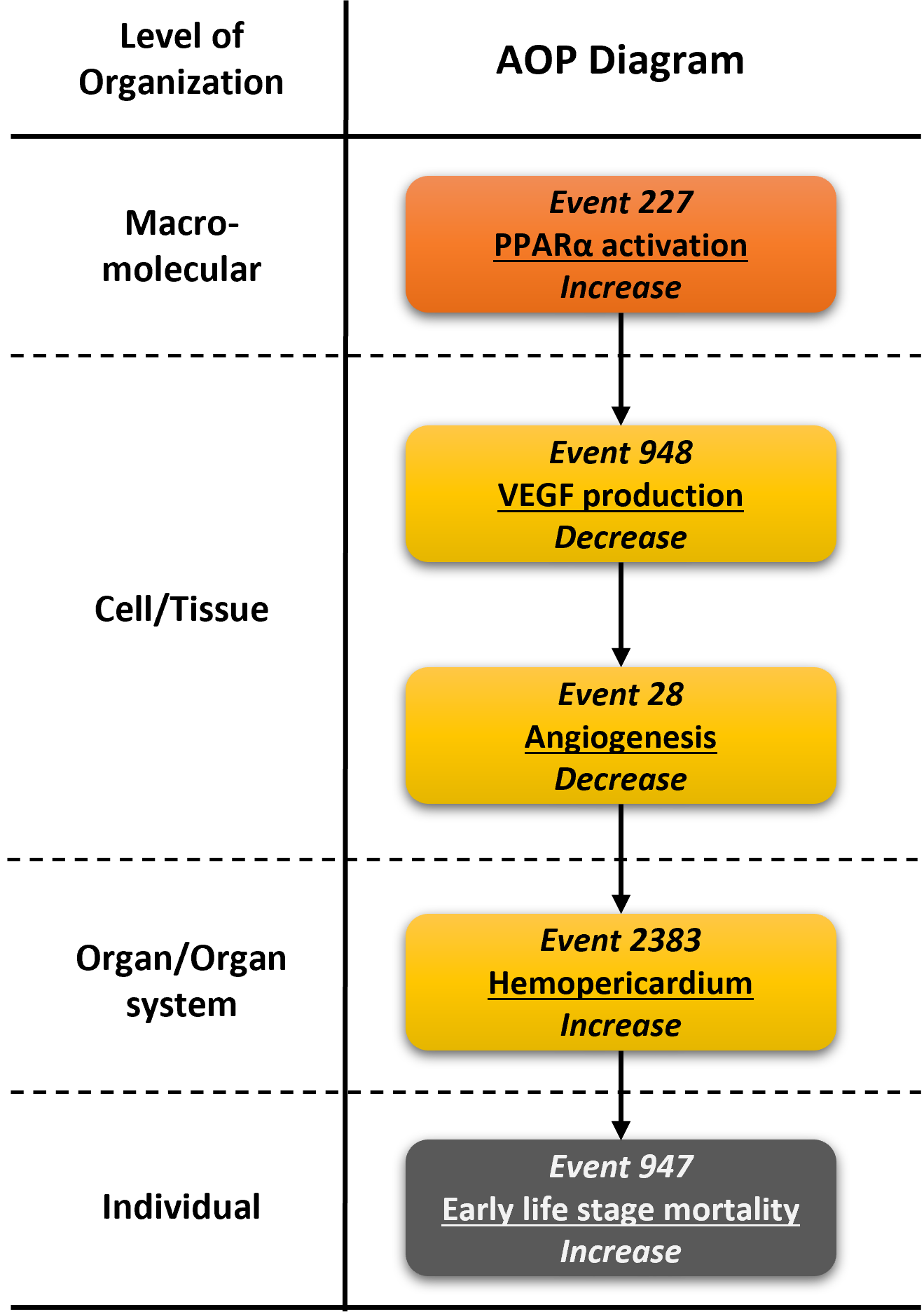
Graphical Representation
Additional AOP Exploration Options
Click links below to explore AOP 614, Peroxisome proliferator-activated receptor alpha activation leading to early life stage mortality via reduced vascular endothelial growth factor in tools offered by third parties.

Point of Contact
Contributors
- You Song
Coaches
OECD Information Table
| OECD Project # | OECD Status | Reviewer's Reports | Journal-format Article | OECD iLibrary Published Version |
|---|---|---|---|---|
This AOP was last modified on November 07, 2025 05:17
Revision dates for related pages
| Page | Revision Date/Time |
|---|---|
| Activation, PPARα | December 28, 2020 12:48 |
| reduced production, VEGF | March 28, 2018 11:48 |
| Reduction, Angiogenesis | July 20, 2022 13:04 |
| Increase, Hemopericardium | October 29, 2025 17:05 |
| Increase, Early Life Stage Mortality | March 22, 2018 10:23 |
| Activation, PPARα leads to reduced production, VEGF | October 30, 2025 04:33 |
| reduced production, VEGF leads to Reduction, Angiogenesis | October 30, 2025 04:34 |
| Reduction, Angiogenesis leads to Increase, Hemopericardium | October 30, 2025 04:34 |
| Increase, Hemopericardium leads to Increase, Early Life Stage Mortality | October 30, 2025 04:19 |
Abstract
This Adverse Outcome Pathway (AOP) describes the mechanistic sequence through which activation of peroxisome proliferator-activated receptor alpha (PPARα) disrupts vascular endothelial growth factor (VEGF) signaling and angiogenesis, ultimately resulting in hemopericardium and increased early life stage mortality in fish. The molecular initiating event (MIE) is PPARα activation, which downregulates VEGF expression, reduces angiogenic sprouting, compromises vascular development, and leads to cardiac failure and death. The AOP integrates molecular regulatory pathways controlling lipid metabolism and vascular growth with developmental toxicity endpoints, providing a mechanistically coherent foundation for assessing cardiovascular and embryotoxic effects of peroxisome proliferators, particularly per- and polyfluoroalkyl substances (PFAS). The AOP supports applications in chemical screening, hazard prioritization, and development of non-animal testing strategies under next-generation risk assessment (NGRA) frameworks.
AOP Development Strategy
Context
This AOP was developed to elucidate a vascular-specific mechanistic route connecting PPARα activation to developmental toxicity. Activation of PPARα, a key transcription factor in lipid metabolism, modulates numerous downstream targets, including suppression of hypoxia-inducible factor 1-alpha (HIF1α) and VEGF expression, both critical regulators of angiogenesis. Impairment of VEGF signaling and reduced vascular branching are frequently observed in zebrafish embryos exposed to PPARα agonists and PFAS. The resulting loss of vascular integrity contributes to hemopericardium and early developmental mortality. This AOP complements existing PPARα- and mitochondrial-centered AOPs by defining a distinct, angiogenesis-focused mechanistic branch.
Strategy
-
Objective: Identify and evaluate mechanistic evidence linking PPARα activation to impaired angiogenesis and embryonic lethality.
-
Data sources: Literature screening in PubMed, AOP-Wiki, OECD AOP-KB, and Web of Science (2010–2025).
-
Key search terms: PPARα activation, VEGF suppression, angiogenesis, vascular development, hemopericardium, zebrafish embryo, PFAS, fibrates.
-
Selection criteria: Experimental studies demonstrating sequential causal relationships, dose–response concordance, or temporal consistency between events.
-
Evaluation: Weight-of-evidence assessment based on OECD (2018) AOP guidance principles—biological plausibility, essentiality, and empirical support.
Summary of the AOP
Events:
Molecular Initiating Events (MIE)
Key Events (KE)
Adverse Outcomes (AO)
| Type | Event ID | Title | Short name |
|---|
| MIE | 227 | Activation, PPARα | Activation, PPARα |
| KE | 948 | reduced production, VEGF | reduced production, VEGF |
| KE | 28 | Reduction, Angiogenesis | Reduction, Angiogenesis |
| KE | 2383 | Increase, Hemopericardium | Increase, Hemopericardium |
| AO | 947 | Increase, Early Life Stage Mortality | Increase, Early Life Stage Mortality |
Relationships Between Two Key Events (Including MIEs and AOs)
| Title | Adjacency | Evidence | Quantitative Understanding |
|---|
Network View
Prototypical Stressors
Life Stage Applicability
| Life stage | Evidence |
|---|---|
| Embryo | |
| Juvenile |
Taxonomic Applicability
| Term | Scientific Term | Evidence | Link |
|---|---|---|---|
| zebrafish | Danio rerio | NCBI |
Sex Applicability
| Sex | Evidence |
|---|---|
| Unspecific |
Overall Assessment of the AOP
The AOP is supported by strong biological plausibility and moderate empirical evidence. Upstream events (PPARα activation and VEGF suppression) are mechanistically well established. Evidence for downstream outcomes (impaired angiogenesis, hemopericardium, mortality) is consistent across fish species and multiple PPARα agonists. Quantitative understanding of the intermediate key event relationships (KERs) is moderate but growing, with transcriptomic and imaging data supporting causal linkages. The overall confidence level is moderate-to-high, making this AOP suitable for chemical screening, read-across, and mechanistic risk assessment applications.
Domain of Applicability
| Aspect | Applicability |
|---|---|
| Taxa | Teleost fish (e.g., Danio rerio, Oryzias latipes); mechanism likely conserved among vertebrates. |
| Life stage | Embryonic and early larval stages. |
| Sex | Non-sex-specific (pre-differentiation). |
| Biological systems | Hepatic (PPARα activation), vascular endothelium (VEGF signaling), and cardiovascular system (angiogenesis and cardiac integrity). |
Essentiality of the Key Events
| Key Event | Essentiality Evidence | Type of Evidence |
|---|---|---|
| Event 227: PPARα activation (MIE) | Knockdown of ppara in zebrafish prevents VEGF suppression and vascular abnormalities following PPARα agonist exposure. | Direct |
| Event 948: VEGF production (Decrease) | VEGF mRNA and protein levels are reduced by PPARα agonists; VEGF mRNA rescue restores angiogenesis. | Direct |
| Event 28: Angiogenesis (Decrease) | Anti-angiogenic phenotypes (reduced intersegmental vessels, impaired sprouting) observed following VEGF suppression. | Direct |
| Event 2383: Hemopericardium (Increase) | Occurs secondary to vascular malformation and cardiac congestion; attenuated by VEGF rescue. | Indirect |
| Event 947: Early life stage mortality (Increase) | Final apical outcome following cumulative vascular collapse. | Outcome |
Evidence Assessment
Biological Plausibility
High. PPARα activation interferes with the HIF1α–VEGF signaling axis, reducing vascular endothelial proliferation and vessel formation. Reduced VEGF signaling has well-documented consequences for angiogenesis and vascular integrity, which align mechanistically with observed cardiac and mortality endpoints in developing fish embryos.
Empirical Support
Moderate to high.
-
Zebrafish and medaka exposed to PPARα agonists (e.g., clofibrate, PFOA, HFPO-DA) show consistent suppression of vegfa transcripts.
-
Inhibition of VEGF signaling recapitulates vascular and cardiac phenotypes identical to those caused by PPARα activation.
-
Temporal concordance is observed: VEGF downregulation → reduced vessel branching → hemopericardium → mortality.
-
Dose–response relationships are evident between PPARα activation markers, VEGF suppression, and observed apical outcomes.
Quantitative Understanding
Moderate. Transcriptomic dose–response data demonstrate ≥40% reduction in vegfa expression correlates with reduced intersegmental vessel count and >50% mortality at high exposure levels. Quantitative models for VEGF-to-angiogenesis linkage are emerging but not yet standardized across taxa.
Known Modulating Factors
| Modulating Factor (MF) | Influence or Outcome | KER(s) Involved |
|---|---|---|
| Oxygen availability | Hypoxia upregulates HIF1α–VEGF signaling, counteracting PPARα-mediated VEGF suppression. | PPARα activation → VEGF decrease |
| Nutritional status | Lipid levels influence PPARα activation strength and downstream vascular effects. | PPARα activation → VEGF decrease |
| Antioxidant capacity | Reduces oxidative stress–mediated modulation of VEGF signaling. | VEGF decrease → angiogenesis decrease |
| Chemical lipophilicity | Determines bioaccumulation and PPARα binding potency. | MIE and downstream effects |
| Developmental stage | Early embryos are more sensitive due to rapid angiogenic processes. | VEGF → angiogenesis → hemopericardium |
Quantitative Understanding
-
Threshold effects: VEGF mRNA reduction >30–40% predicts loss of angiogenic sprouting.
-
Temporal sequence: VEGF suppression within 24–36 h post-exposure precedes angiogenic defects and hemopericardium by 12–24 h.
-
Model potential: Dose–response and time-series data from zebrafish enable semi-quantitative modeling for VEGF–angiogenesis relationships.
Considerations for Potential Applications of the AOP (optional)
-
Regulatory screening: Supports the prioritization of chemicals with PPARα agonist activity for developmental vascular toxicity.
-
Read-across: Enables grouping of PFAS, fibrates, and related lipid modulators based on shared mechanistic profiles.
-
NAM integration: Aligns with transcriptomic biomarkers (PPARα target genes, vegfa repression) for use in in vitro assays.
-
Test guideline refinement: May inform OECD Fish Embryo Test (TG 236) adaptations to include vascular endpoints.
-
Risk assessment: Provides mechanistic rationale for linking molecular bioactivity data to early life stage lethality outcomes.