
This AOP is licensed under the BY-SA license. This license allows reusers to distribute, remix, adapt, and build upon the material in any medium or format, so long as attribution is given to the creator. The license allows for commercial use. If you remix, adapt, or build upon the material, you must license the modified material under identical terms.
AOP: 628
Title
Increased 11β-Hydroxysteroid dehydrogenase type 1 activity leading to MASLD progression via lipogenesis-associated oxidative stress
Short name
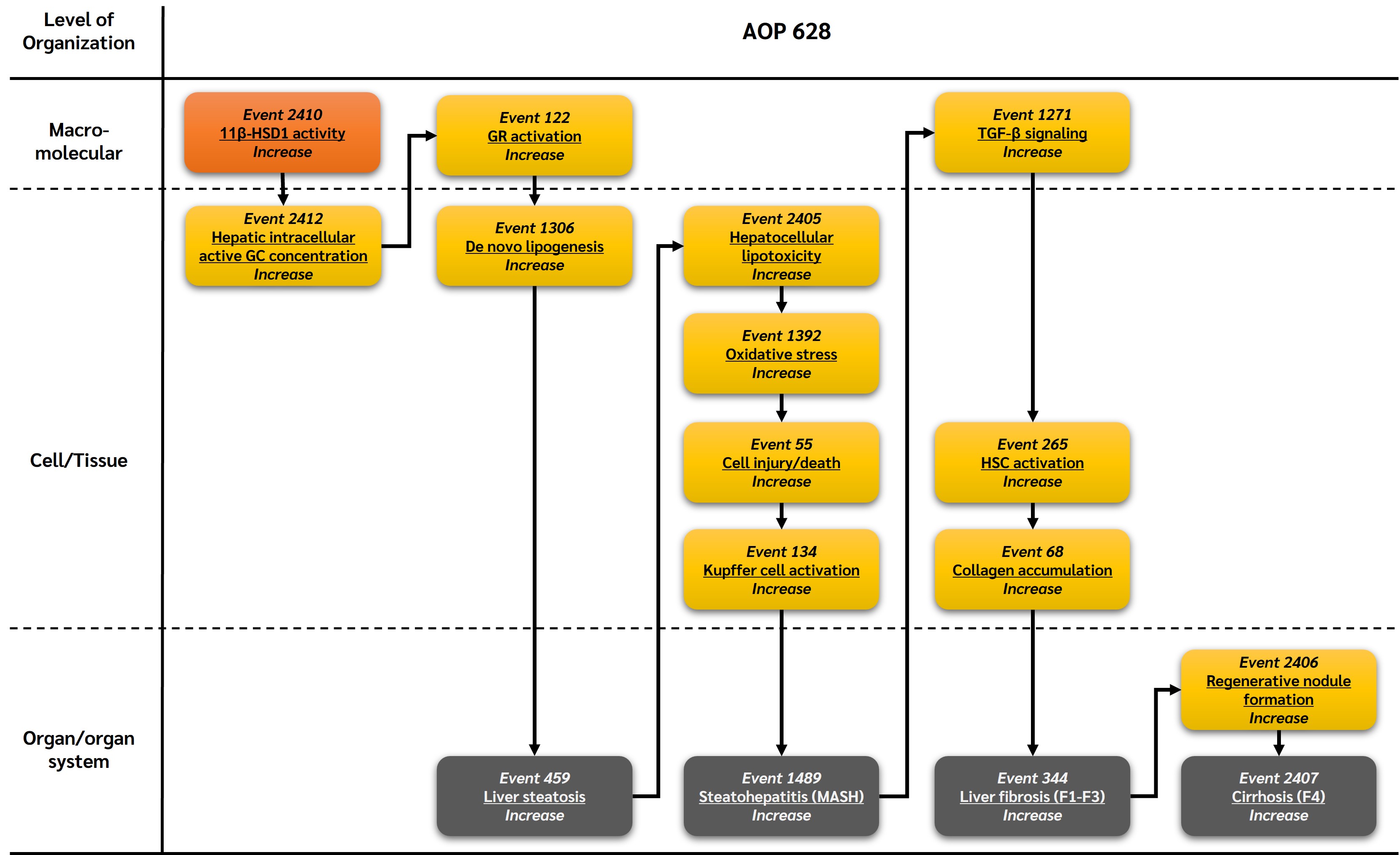
Graphical Representation
Additional AOP Exploration Options
Click links below to explore AOP 628, Increased 11β-Hydroxysteroid dehydrogenase type 1 activity leading to MASLD progression via lipogenesis-associated oxidative stress in tools offered by third parties.

Point of Contact
Contributors
- You Song
Coaches
- Shihori Tanabe
OECD Information Table
| OECD Project # | OECD Status | Reviewer's Reports | Journal-format Article | OECD iLibrary Published Version |
|---|---|---|---|---|
| Under Development |
This AOP was last modified on February 26, 2026 04:15
Revision dates for related pages
| Page | Revision Date/Time |
|---|---|
| Increase, 11β-Hydroxysteroid dehydrogenase type 1 activity | February 18, 2026 08:38 |
| Increase, Hepatic intracellular active glucocorticoids | February 26, 2026 06:48 |
| Increase, Glucocorticoid receptor activation | February 12, 2026 07:24 |
| Increase, De novo lipogenesis | February 10, 2026 04:39 |
| Increase, Liver steatosis | February 11, 2026 05:41 |
| Increase, Hepatocellular lipotoxicity | February 10, 2026 04:40 |
| Increase, Oxidative Stress | September 02, 2026 04:19 |
| Increase, Cell injury/death | September 02, 2026 04:23 |
| Increase, Kupffer cell activation | February 11, 2026 05:16 |
| Increase, Steatohepatitis | February 24, 2026 09:13 |
| Increase, Transforming growth factor-beta signaling | February 11, 2026 05:39 |
| Increase, Hepatic stellate cell activation | February 11, 2026 07:04 |
| Increase, Collagen accumulation | February 11, 2026 06:58 |
| Increase, Liver fibrosis | February 11, 2026 05:35 |
| Increase, Regenerative nodule formation | February 10, 2026 06:47 |
| Increase, Cirrhosis | February 11, 2026 07:34 |
| Increase, 11β-HSD1 activity leads to Increase, Hepatic intracellular active GC | February 24, 2026 08:32 |
| Increase, Hepatic intracellular active GC leads to Increase, GR activation | February 24, 2026 08:32 |
| Increase, GR activation leads to Increase, De novo lipogenesis | February 12, 2026 07:41 |
| Increase, De novo lipogenesis leads to Increase, Liver steatosis | February 11, 2026 05:41 |
| Increase, Liver steatosis leads to Increase, Hepatocellular lipotoxicity | February 10, 2026 08:59 |
| Increase, Hepatocellular lipotoxicity leads to Increase, Oxidative Stress | February 24, 2026 08:47 |
| Increase, Oxidative Stress leads to Cell injury/death | February 07, 2020 09:32 |
| Cell injury/death leads to Increase, Kupffer cell activation | November 29, 2016 19:54 |
| Increase, Kupffer cell activation leads to Increase, Steatohepatitis | February 10, 2026 09:00 |
| Increase, Steatohepatitis leads to Activation of TGF-β signaling | February 10, 2026 09:00 |
| Activation of TGF-β signaling leads to Increase, HSC activation | February 10, 2026 09:01 |
| Increase, HSC activation leads to Increase, Collagen accumulation | December 05, 2018 08:51 |
| Increase, Collagen accumulation leads to Increase, Liver fibrosis | December 05, 2018 08:52 |
| Increase, Liver fibrosis leads to Increase, Regenerative nodule formation | February 10, 2026 09:02 |
| Increase, Regenerative nodule formation leads to Increase, Cirrhosis | February 10, 2026 09:02 |
Abstract
This adverse outcome pathway (AOP) describes a mechanistic sequence linking altered glucocorticoid receptor (GR) signaling to the progression of metabolic dysfunction–associated steatotic liver disease (MASLD) through impaired hepatic very-low-density lipoprotein (VLDL) export and subsequent endoplasmic reticulum (ER) stress. Disruption of GR signaling reduces VLDL assembly and secretion, leading to intrahepatic lipid retention and hepatocellular lipotoxicity. Accumulation of lipids within the ER overwhelms protein and lipid handling capacity, inducing ER stress and maladaptive unfolded protein response signaling. Sustained ER stress promotes hepatocyte injury, inflammatory activation, and profibrotic signaling, including TGF-β–mediated hepatic stellate cell activation. These processes drive disease progression from steatosis to steatohepatitis (MASH), fibrosis, and ultimately cirrhosis. This AOP provides a biologically plausible and regulatory-relevant framework for identifying endocrine-disrupting chemicals (EDCs) that promote MASLD progression through GR-mediated disruption of hepatic lipid export and ER homeostasis.
AOP Development Strategy
Context
Efficient export of triglycerides via VLDL is essential for maintaining hepatocellular lipid balance and preventing intracellular lipid overload. Impairment of VLDL assembly or secretion results in lipid accumulation within hepatocytes, particularly within the endoplasmic reticulum, where lipoprotein assembly occurs. This accumulation can directly disrupt ER membrane integrity and protein folding capacity, leading to ER stress.
Glucocorticoid receptor (GR) signaling regulates multiple aspects of hepatic lipid metabolism, including lipoprotein assembly, apolipoprotein expression, and triglyceride trafficking. Altered GR signaling—whether through dysregulation or chemical interference—can suppress VLDL export independently of changes in lipid influx or insulin sensitivity. This AOP was developed to capture ER stress as a direct consequence of impaired lipid export, providing a mechanistically distinct pathway linking GR disruption to MASLD progression.
Strategy
This AOP was developed using an expert-driven conceptual framework supported by targeted literature evaluation across endocrinology, hepatic lipid metabolism, ER stress biology, and chronic liver disease. Initial scoping identified reduced VLDL export as a key mechanistic driver of ER stress and downstream liver injury.
Focused literature searches were conducted to identify evidence supporting:
-
GR regulation of VLDL assembly and secretion
-
Effects of impaired VLDL export on hepatic lipid retention
-
Induction of ER stress by intracellular lipid accumulation
-
ER stress–mediated hepatocyte injury and inflammatory signaling
-
Fibrogenic pathways involving TGF-β signaling and hepatic stellate cell activation
Evidence from human clinical studies, animal models, and mechanistic in vitro systems was prioritized, with emphasis on chronic perturbations relevant to endocrine disruption.
Summary of the AOP
Events:
Molecular Initiating Events (MIE)
Key Events (KE)
Adverse Outcomes (AO)
| Type | Event ID | Title | Short name |
|---|
| MIE | 2410 | Increase, 11β-Hydroxysteroid dehydrogenase type 1 activity | Increase, 11β-HSD1 activity |
| KE | 2412 | Increase, Hepatic intracellular active glucocorticoids | Increase, Hepatic intracellular active GC |
| KE | 122 | Increase, Glucocorticoid receptor activation | Increase, GR activation |
| KE | 1306 | Increase, De novo lipogenesis | Increase, De novo lipogenesis |
| KE | 2405 | Increase, Hepatocellular lipotoxicity | Increase, Hepatocellular lipotoxicity |
| KE | 1392 | Increase, Oxidative Stress | Increase, Oxidative Stress |
| KE | 55 | Increase, Cell injury/death | Cell injury/death |
| KE | 134 | Increase, Kupffer cell activation | Increase, Kupffer cell activation |
| KE | 1271 | Increase, Transforming growth factor-beta signaling | Activation of TGF-β signaling |
| KE | 265 | Increase, Hepatic stellate cell activation | Increase, HSC activation |
| KE | 68 | Increase, Collagen accumulation | Increase, Collagen accumulation |
| KE | 2406 | Increase, Regenerative nodule formation | Increase, Regenerative nodule formation |
| AO | 459 | Increase, Liver steatosis | Increase, Liver steatosis |
| AO | 1489 | Increase, Steatohepatitis | Increase, Steatohepatitis |
| AO | 344 | Increase, Liver fibrosis | Increase, Liver fibrosis |
| AO | 2407 | Increase, Cirrhosis | Increase, Cirrhosis |
Relationships Between Two Key Events (Including MIEs and AOs)
| Title | Adjacency | Evidence | Quantitative Understanding |
|---|
Network View
Prototypical Stressors
Life Stage Applicability
Taxonomic Applicability
Sex Applicability
Overall Assessment of the AOP
This AOP is biologically plausible and supported by moderate to strong empirical evidence linking impaired hepatic lipid export to ER stress and progressive liver injury. The sequence of key events reflects conserved cellular stress responses and fibrogenic mechanisms observed across mammalian species.
The AOP is particularly well suited for hazard identification and prioritization of chemicals that disrupt GR-regulated lipid handling without necessarily inducing insulin resistance or increased lipid influx. It complements other GR-mediated MASLD AOPs by highlighting ER stress as a downstream consequence of defective VLDL export.
Domain of Applicability
-
Taxa: Mammals (humans and laboratory rodents)
-
Life stage: Primarily adolescents and adults
-
Sex: Applicable to both sexes; sex-dependent differences may occur due to hormonal modulation of lipid metabolism
-
Biological context: Chronic endocrine perturbation, impaired lipoprotein metabolism, metabolic stress
This AOP is not intended to describe acute hepatotoxicity and is most applicable to chronic exposure scenarios.
Essentiality of the Key Events
Evidence supporting the essentiality of the key events includes:
-
Altered GR signaling: Experimental modulation of GR activity affects hepatic lipid handling and VLDL secretion.
-
Reduced VLDL export: Genetic or pharmacological impairment of VLDL assembly leads to hepatic lipid accumulation and ER stress.
-
ER stress: Attenuation of ER stress responses reduces hepatocyte injury and inflammatory signaling in MASLD models.
-
Inflammatory and fibrogenic activation: Inhibition of Kupffer cell activation, hepatic stellate cell activation, or TGF-β signaling mitigates fibrosis progression.
Together, these findings support the causal role of each KE in driving downstream MASLD outcomes.
Evidence Assessment
Across the KERs in this AOP:
-
Biological plausibility is strong, based on established roles of VLDL export in hepatocyte lipid and ER homeostasis.
-
Empirical support is moderate to strong, with consistent evidence across in vivo and in vitro systems.
-
Quantitative understanding is limited, particularly regarding thresholds for ER stress induction following impaired lipid export.
Overall, the weight of evidence supports confidence in the pathway for regulatory-relevant applications.
Known Modulating Factors
| Modulating Factor (MF) | Influence or Outcome | KER(s) involved |
|---|---|---|
| Dietary lipid load | Exacerbates lipid accumulation when VLDL export is impaired | VLDL export ↓ → ER stress |
| Apolipoprotein availability | Modulates efficiency of VLDL assembly | GR signaling → VLDL export |
| ER chaperone capacity | Influences resilience to lipid-induced ER stress | ER stress → cell injury |
| Inflammatory milieu | Amplifies hepatocyte injury and fibrogenesis | Cell injury → fibrosis |
Quantitative Understanding
Quantitative data exist for relationships between impaired VLDL export, hepatic lipid accumulation, and ER stress marker induction. However, quantitative integration across downstream inflammatory and fibrotic events remains limited. Accordingly, this AOP is best applied qualitatively or semi-quantitatively.
Considerations for Potential Applications of the AOP (optional)
This AOP may support:
-
Identification of GR-modulating chemicals that impair hepatic lipid export
-
Integration of ER stress endpoints into MASLD-relevant testing strategies
-
Complementary assessment of ER-centric mechanisms alongside mitochondrial stress pathways
-
Construction of AOP networks capturing convergent routes to MASLD progression