
This AOP is licensed under the BY-SA license. This license allows reusers to distribute, remix, adapt, and build upon the material in any medium or format, so long as attribution is given to the creator. The license allows for commercial use. If you remix, adapt, or build upon the material, you must license the modified material under identical terms.
AOP: 324
Title
Increase in reactive oxygen species leading to growth inhibition via oxidative DNA damage and cell cycle disruption
Short name
Graphical Representation
Additional AOP Exploration Options
Click links below to explore AOP 324, Increase in reactive oxygen species leading to growth inhibition via oxidative DNA damage and cell cycle disruption in tools offered by third parties.

Point of Contact
Contributors
- You Song
Coaches
- Shihori Tanabe
OECD Information Table
| OECD Project # | OECD Status | Reviewer's Reports | Journal-format Article | OECD iLibrary Published Version |
|---|---|---|---|---|
| Under Development |
This AOP was last modified on September 02, 2026 03:18
Revision dates for related pages
| Page | Revision Date/Time |
|---|---|
| Increase, Reactive oxygen species | June 12, 2025 01:27 |
| Increase, Oxidative Stress | September 02, 2026 04:19 |
| Increase, Oxidative DNA damage | September 02, 2026 04:20 |
| Inadequate DNA repair | September 02, 2026 04:21 |
| Increase, DNA strand breaks | September 02, 2026 04:21 |
| Increase, Cell cycle disruption | September 02, 2026 04:22 |
| Decrease, Cell proliferation | September 02, 2026 04:24 |
| Decrease, Growth | September 02, 2026 03:23 |
| Increase, ROS leads to Increase, Oxidative Stress | June 23, 2026 06:57 |
| Increase, Oxidative Stress leads to Increase, Oxidative DNA damage | March 08, 2024 14:39 |
| Increase, Oxidative DNA damage leads to Inadequate DNA repair | March 08, 2024 14:48 |
| Inadequate DNA repair leads to Increase, DNA strand breaks | September 22, 2026 22:09 |
| Increase, DNA strand breaks leads to Cell cycle disruption | January 20, 2025 03:50 |
| Cell cycle disruption leads to Decrease, Cell proliferation | June 23, 2026 08:08 |
| Decrease, Cell proliferation leads to Decrease, Growth | July 06, 2022 07:43 |
| Hydrogen peroxide | May 19, 2019 17:21 |
| Paraquat | November 29, 2016 18:42 |
| tert-Butyl hydroperoxide | May 19, 2019 17:24 |
| Ionizing Radiation | May 07, 2019 12:12 |
| Ultraviolet B radiation | April 15, 2017 16:04 |
| Silver | February 03, 2022 11:20 |
| Silver nanoparticles | February 15, 2017 03:19 |
| Heavy metals (cadmium, lead, copper, iron, nickel) | October 25, 2021 03:21 |
Abstract
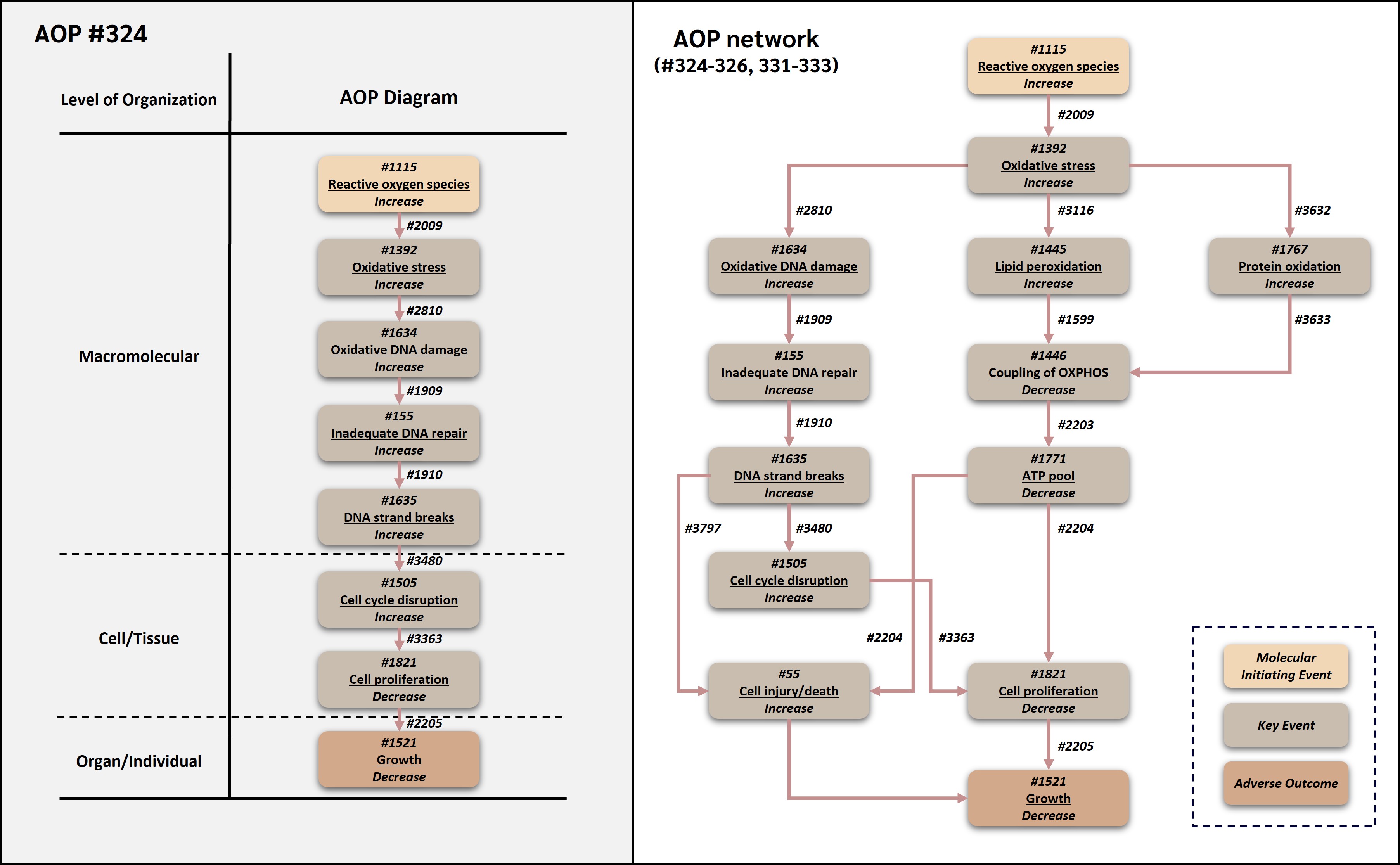
This adverse outcome pathway (AOP 324) describes a linear genotoxic route by which increased reactive oxygen species (ROS) can lead to decreased organismal growth. In this AOP, increased ROS is treated operationally as the molecular initiating event (MIE) because it represents the earliest common measurable redox perturbation shared by many stressors within the broader ROS-mediated AOP networks. Increased ROS leads to oxidative stress, which causes oxidative DNA damage. When oxidative DNA lesions exceed or impair repair capacity, inadequate DNA repair can occur, allowing DNA strand breaks to accumulate. Strand breaks activate cell cycle checkpoint responses and disrupt progression through the cell cycle. Sustained cell cycle disruption reduces cell proliferation, and reduced cell proliferation ultimately contributes to decreased growth.
The AOP reuses and connects existing AOP-Wiki components, including key events (KEs) and key event relationships (KERs) from OECD/WPHA-WNT endorsed AOPs. In particular, the oxidative DNA damage module is derived from AOP 296, the oxidative stress and DNA damage context is supported by AOP 478, the cell-cycle disruption KE is shared with AOP 212, and the link from decreased cell proliferation to decreased growth is reused from AOP 263 (AOP-Wiki, 2026a, 2026b, 2026c, 2026d; OECD, 2022, 2023; Carrothers et al., 2025). The AOP is biologically plausible across aerobic eukaryotes because ROS metabolism, antioxidant defenses, DNA damage response pathways, DNA repair, cell cycle regulation, and growth processes are broadly conserved. Empirical support is derived from studies in algae, fish embryos and cell lines, mammalian cells, and other systems exposed to oxidative or genotoxic stressors. The AOP is expected to be useful for mechanistic interpretation of oxidative stress-related toxicity, support of integrated approaches to testing and assessment (IATA), and prioritization of stressors that produce oxidative DNA damage and growth impairment.
Acknowledgement
This project was funded by the Research Council of Norway (RCN), grant no. RCN-315929 “EXPECT: In silico and experimental screening platform for characterizing environmental impact of industry development in the Arctic” (https://www.niva.no/en/projects/expect), the European Partnership for the Assessment of Risks from Chemicals (PARC) through European Union’s Horizon Europe research and innovation programme (Grant Agreement No 101057014, and supported by the NIVA Computational Toxicology Program, NCTP (https://www.niva.no/en/featured-pages/nctp, grant. No. RCN-342628).
AI disclosure
Artificial intelligence (AI) tools were used to support literature prioritization, review and AOP-Wiki page preparation in this work. AOP-helpFinder was used for automated literature mining, and ChatGPT (OpenAI) was used as an auxiliary tool for title and abstract screening, extraction of study metadata, and identification of potential weight-of-evidence indicators. AI-assisted outputs were used only to organize and prioritize information and were verified against the original sources by the authors before inclusion. Additional AI assistance was used for formatting, copy-editing, citation cross-checking, and harmonization of the AOP-Wiki pages. All scientific interpretations, weight-of-evidence judgments, final wording, and conclusions were determined and approved by the authors, who take full responsibility for the content and integrity of the work.
AOP Development Strategy
Context
ROS are continuously formed during aerobic metabolism and are also generated in response to environmental stressors. At controlled levels, ROS participate in redox signaling, while excessive ROS can disturb redox homeostasis and initiate oxidative damage to cellular macromolecules (Schieber and Chandel, 2014; Sies et al., 2017). DNA is a major target of oxidative attack. Oxidative DNA lesions such as 8-oxo-2'-deoxyguanosine and other oxidized bases can arise endogenously or following toxic insult, and these lesions may contribute to mutation, strand break formation, and activation of DNA damage responses if they are not repaired correctly or efficiently (Cooke et al., 2003; OECD, 2023).
This AOP was developed to represent the DNA damage-driven linear route within the broader ROS-growth AOP network. The route was selected because oxidative DNA damage is a well-established consequence of oxidative stress and because downstream events such as inadequate DNA repair, strand breaks, cell cycle disruption, and reduced cell proliferation provide a mechanistically coherent bridge between molecular damage and decreased organismal growth (Cuddihy and O'Connell, 2003; Conlon and Raff, 1999; OECD, 2022; OECD, 2023). The AOP was therefore designed to provide a focused, reviewable linear representation of one major mechanistic branch by which excessive ROS can impair growth.
Strategy
AOP 324 was developed using the principles described in OECD AOP guidance, including modular description of KEs and KERs, reuse of existing AOP-Wiki content where appropriate, evidence evaluation using biological plausibility, empirical support, essentiality, and quantitative understanding, and clear description of the biological domain of applicability (OECD, 2018, 2021). The intent was not to create a fully de novo set of biological objects, but to assemble a linear AOP from established and reusable AOP-Wiki components wherever possible. This modular strategy is important because the AOP is part of a broader ROS-growth AOP network and because its individual KEs and KERs are expected to be reused in other oxidative stress, genotoxicity, and growth impairment AOPs.
Existing AOP-Wiki content and OECD-endorsed AOPs were reviewed at an early stage to identify KEs and KERs that could be reused directly, adapted, or used as supporting context. AOP 296 was the primary source for the oxidative DNA damage module. It is an endorsed AOP describing oxidative DNA damage leading to chromosomal aberrations and mutations and includes KE 1634 (Increase, Oxidative DNA damage), KE 155 (Inadequate DNA repair), KE 1635 (Increase, DNA strand breaks), and relationships involving oxidative DNA damage, inadequate DNA repair, and strand break formation (AOP-Wiki, 2026b; OECD, 2023). AOP 478, an endorsed AOP on deposition of energy leading to cataracts, provided additional support for the upstream oxidative stress context, including KE 1392 (Oxidative stress), KE 1634, KE 155, KE 1635, and the relationship from oxidative stress to oxidative DNA damage in a radiation-relevant setting (AOP-Wiki, 2026a; Carrothers et al., 2025). AOP 212 was reviewed because it contains KE 1505 (Cell cycle, disrupted) and evidence that disruption of cell-cycle regulation can lead to downstream changes in cell fate (AOP-Wiki, 2026c). AOP 263 was reviewed because it is an endorsed AOP linking decreased cell proliferation to decreased growth, and AOP 324 reuses the downstream KE 1821 (Decrease, Cell proliferation), AO 1521 (Decrease, Growth), and KER 2205 (Decrease, Cell proliferation leads to Decrease, Growth) from that AOP (AOP-Wiki, 2026d; OECD, 2022; Song and Villeneuve, 2021).
In accordance with the OECD AOP coaching checklist (ver. 2024-10-30), the lead author (Y. Song) have communicated with the authors of the following existing KEs and KERs that are reused or expanded in this AOPN: KE 1115 (Mystery of ROS consortium, coordinated by S. Tanabe, NIHS Japan); KE 1392, KE 1634, KE 155, KE 1635, KER 2810, KER 1909, KER 1910 (AOP 296 and AOP 478: C. Yauk, University of Ottawa; V. Chauhan, Health Canada); KE 1505 (AOP 212: S. Tanabe, NIHS Japan); KE 55 (AOPs 12, 13, 17, 38, 48: relevant corresponding authors notified); KE 1446, KE 1771, KE 1821, KE 1521, KER 2203, KER 2204, KER 2205 (AOP 263: Y. Song, NIVA). Notification documentation is available from the corresponding author on request.
The resulting AOP 324 therefore represents an upstream extension and re-routing of established AOP-Wiki knowledge. Compared with AOP 296, AOP 324 extends upstream from oxidative DNA damage to increased ROS and oxidative stress and extends downstream from DNA damage response biology to decreased cell proliferation and growth. Compared with AOP 263, it reuses the final growth-relevant segment but provides a different upstream causal route, namely oxidative DNA damage and cell-cycle disruption rather than mitochondrial uncoupling and ATP depletion. Compared with AOP 478, it reuses the oxidative stress-DNA damage portion of the radiation AOP but directs that conserved genotoxic sequence toward growth inhibition rather than cataract formation. Compared with AOP 212, it reuses cell-cycle disruption as a modular KE but places it in the context of DNA strand break-mediated checkpoint activation rather than histone deacetylase inhibition.
The literature review and evidence assembly process followed an AI-human hybrid workflow. The first phase consisted of AOP-helpFinder searching and preliminary analysis. Search terms were developed for each event in the pathway, including KE names, common synonyms, endpoint terms, assay terms, taxonomic descriptors, and relevant species names. These terms were used in AOP-helpFinder to search PubMed for co-occurrence patterns between key events and related mechanistic concepts, following published approaches for literature mining in support of AOP development (Carvaillo et al., 2019; Jornod et al., 2022). The exported results included PMIDs, titles, abstracts, and matched key-event terms. These outputs were subjected to overlap analysis to remove redundant records and to filter the initial literature pool, including elimination of clearly irrelevant records and separation of taxa-related evidence where needed.
The second phase consisted of ChatGPT (OpenAI, San Francisco, CA, USA)-assisted screening. Titles and abstracts from AOP-helpFinder, together with records identified from targeted manual searches, were pre-screened using an large language model (LLM) as an auxiliary prioritization tool. The purpose of this step was not to replace expert judgment, but to increase efficiency and consistency during early evidence triage. The LLM was used to extract study metadata, including stressor, species, biological system, dose or concentration, and exposure duration; identify the evidence type represented in each study, such as biological plausibility, empirical support, or essentiality; and flag weight-of-evidence indicators including dose-response concordance, temporal concordance, incidence concordance, and intervention or rescue evidence. Studies were provisionally classified as high relevance, medium relevance, or low relevance.
High-relevance studies were retrieved for full-text review, whereas medium-relevance studies were retained as potential supporting evidence. Low-relevance studies were documented as low priority and excluded from detailed curation. For studies moved forward to full-text review, a second LLM-assisted pass was used to organize relevant information from the full paper. All LLM-generated outputs were checked directly against the original article text by human reviewers. The LLM was therefore used only as a screening and structuring aid, not as an independent evaluator of the evidence.
Data and methods availability: The literature evidence triage records, including AOP-helpFinder search term libraries, ChatGPT (OpenAI, San Francisco, CA, USA) screening outputs, and human reviewer verification notes, are available from the corresponding author (you.song@niva.no) upon request. All ChatGPT-assisted screening outputs were verified against the original article text by at least one human expert reviewer before any evidence was accepted into KER evidence tables. ChatGPT was used only as an auxiliary prioritization and metadata-extraction tool and not as an independent evaluator of scientific content. The final snapshot PDF of this AOP and the review process PDF will be deposited at the AOP-Wiki forum following completion of the coaching compliance check.
The final phase consisted of manual expert curation and weight-of-evidence evaluation. Domain experts verified the relevance and interpretation of the literature selected in the earlier stages, resolved ambiguous cases, and extracted information to populate KER evidence tables. These tables captured the biological system studied, stressor, method, endpoint, result, concordance pattern, weight-of-evidence category, and bibliographic source. Expert review was then used to evaluate the evidence for each KER in terms of biological plausibility, empirical support, essentiality, quantitative understanding, and evidence gaps. Targeted manual searches were also used to fill specific gaps for ROS biology, oxidative DNA damage, DNA repair, DNA strand breaks, DNA damage response, cell cycle disruption, cell proliferation, and growth inhibition. Studies were prioritized when they measured two or more KEs in the same biological system, reported exposure time and dose or concentration, or provided evidence relevant to dose-response, temporal, or incidence concordance. Mechanistic reviews and OECD reports were used primarily to support biological plausibility, whereas primary experimental studies were prioritized for empirical support wherever possible (Cooke et al., 2003; Cuddihy and O'Connell, 2003; Qian et al., 2009; Hlavová et al., 2011; Quevedo et al., 2021; OECD, 2023).
Summary of the AOP
Events:
Molecular Initiating Events (MIE)
Key Events (KE)
Adverse Outcomes (AO)
| Type | Event ID | Title | Short name |
|---|
| MIE | 1115 | Increase, Reactive oxygen species | Increase, ROS |
| KE | 1392 | Increase, Oxidative Stress | Increase, Oxidative Stress |
| KE | 1634 | Increase, Oxidative DNA damage | Increase, Oxidative DNA damage |
| KE | 155 | Inadequate DNA repair | Inadequate DNA repair |
| KE | 1635 | Increase, DNA strand breaks | Increase, DNA strand breaks |
| KE | 1505 | Increase, Cell cycle disruption | Cell cycle disruption |
| KE | 1821 | Decrease, Cell proliferation | Decrease, Cell proliferation |
| AO | 1521 | Decrease, Growth | Decrease, Growth |
Relationships Between Two Key Events (Including MIEs and AOs)
| Title | Adjacency | Evidence | Quantitative Understanding |
|---|
| Increase, ROS leads to Increase, Oxidative Stress | adjacent | High | Moderate |
| Increase, Oxidative Stress leads to Increase, Oxidative DNA damage | adjacent | High | Moderate |
| Increase, Oxidative DNA damage leads to Inadequate DNA repair | adjacent | High | Low |
| Inadequate DNA repair leads to Increase, DNA strand breaks | adjacent | High | Low |
| Increase, DNA strand breaks leads to Cell cycle disruption | adjacent | High | Moderate |
| Cell cycle disruption leads to Decrease, Cell proliferation | adjacent | High | Moderate |
| Decrease, Cell proliferation leads to Decrease, Growth | adjacent | High | Moderate |
Network View
Prototypical Stressors
Life Stage Applicability
| Life stage | Evidence |
|---|---|
| All life stages | Moderate |
Taxonomic Applicability
Sex Applicability
| Sex | Evidence |
|---|---|
| Unspecific | High |
Overall Assessment of the AOP
The overall weight of evidence (WoE) supporting AOP 324 is considered moderate. Biological plausibility is high for all seven KERs in the pathway, reflecting well-established mechanistic connections between ROS accumulation, oxidative stress, oxidative DNA damage, inadequate DNA repair, DNA strand break formation, cell cycle checkpoint activation, reduced cell proliferation, and decreased growth. This biological coherence is reinforced by the reuse of curated KEs and KERs from OECD-endorsed AOPs 263, 296, 478, and 212, which independently support each module in the pathway. Empirical support is high for the upstream (ROSàoxidative stress, oxidative stressàDNA damage relationships), and decreases progressively toward the downstream cell cycle disruption and reduced cell proliferation events, where cross-KE studies in the same biological system are less common. Essentiality of the KEs is rated moderate for most events, reflecting mechanistic support and some intervention evidence but the absence of fully selective, pathway-specific blocking experiments across the whole AOP. Quantitative understanding is low to moderate for most KERs, with the exception of the cell proliferationàgrowth relationship reused from AOP 263, which has moderate quantitative support. The main uncertainties include the relative contribution of the genotoxic route compared with other branches of the broader ROS-growth AOP network, the dual role of ROS in physiological signaling versus toxicological damage, and the multifactorial nature of growth as an apical endpoint. Given the current state of evidence, AOP 324 is most suitable for qualitative and semi-quantitative applications, including mechanistic interpretation of oxidative DNA-damage-driven growth impairment, chemical prioritization, and support for integrated approaches to testing and assessment (IATA). More quantitative regulatory applications will require further empirical studies measuring multiple KEs in the same biological system and under the same stressor exposure (OECD, 2018; Becker et al., 2015).
Domain of Applicability
The biological domain of applicability of AOP 324 is defined by the conservation of the KEs and KERs linking oxidative DNA damage to impaired proliferation and growth. The AOP is applicable to aerobic eukaryotic systems in which ROS can oxidize DNA, DNA repair and checkpoint responses regulate genomic integrity, cell cycle progression determines proliferation, and proliferation contributes to growth. The AOP is most relevant to developmental or actively growing systems, including algae, embryos, larvae, juveniles, and proliferative tissues.
The stressor domain is broad but not unlimited. Stressors are relevant when they generate ROS, impair antioxidant defenses, induce oxidative DNA lesions, or produce DNA strand breaks through mechanisms that converge on oxidative damage and checkpoint activation. Examples include redox-cycling organic chemicals, peroxides, metals, nanoparticles, ionizing radiation, ultraviolet radiation, and other stressors capable of producing oxidative DNA damage. The AOP should not be used where decreased growth is driven primarily by mechanisms unrelated to oxidative DNA damage or cell-cycle disruption.
Essentiality of the Key Events
Essentiality was evaluated at the AOP level by considering whether modification of an upstream KE would be expected to prevent, attenuate, or alter downstream KEs and/or the AO. Because many KEs in this AOP represent conserved cellular stress-response processes, direct essentiality evidence is strongest for some biological modules and weaker for others. Evidence is summarized below.
|
Key event |
Essentiality |
Rationale |
Experimental manipulation evidence (KE knock-out / inhibition / rescue) |
Uncertainties |
|
Event 1115: Reactive oxygen species, increased |
Moderate |
ROS are causally linked to oxidative stress because oxidative stress occurs when oxidant formation exceeds antioxidant capacity. Antioxidant and radical-scavenging interventions can reduce oxidative stress and oxidative DNA damage in many systems, supporting the importance of ROS as an upstream driver (Schieber and Chandel, 2014; Sies et al., 2017; OECD, 2023). |
Indirect: antioxidant and ROS-scavenger pre-treatment reduces oxidative stress and downstream damage across oxidative-stress models (Schieber and Chandel, 2014; Sies et al., 2017). No selective single-source ROS knock-out is available. |
ROS can also function in physiological signaling at low levels; oxidative stress can be sustained by altered antioxidant capacity even when a specific ROS source is removed. |
|
Event 1392: Oxidative stress, increased |
High |
Oxidative stress provides the biochemical context for oxidative DNA damage. Excess ROS and redox imbalance can oxidize DNA bases and promote strand breaks; AOP 478 and AOP 296 both use oxidative stress/oxidative DNA damage relationships as central components of endorsed AOP logic (AOP-Wiki, 2026a, 2026b; Cooke et al., 2003; Carrothers et al., 2025; OECD, 2023). |
Indirect: modulation of antioxidant capacity alters progression to oxidative macromolecular damage; oxidative stress is the curated hub KE in endorsed AOP 478 (AOP-Wiki, 2026a; Carrothers et al., 2025). |
Cellular antioxidant and DNA repair capacity can delay or prevent progression to downstream events. |
|
Event 1634: Oxidative DNA damage, increased |
Moderate to high |
AOP 296 identifies oxidative DNA damage as a core initiating event for irreversible genomic damage and reports support from studies using ROS scavengers and DNA repair modulation (AOP-Wiki, 2026b; OECD, 2023). Oxidative lesions such as 8-oxo-dG are mechanistically linked to repair demand and strand break formation (Cooke et al., 2003). |
Indirect: ROS-scavenger and DNA-repair-modulation studies referenced in endorsed AOP 296 alter oxidative DNA lesion burden (AOP-Wiki, 2026b; OECD, 2023; Cooke et al., 2003). |
Direct intervention studies that isolate oxidative DNA damage while keeping other ROS-mediated damage constant are limited. |
|
Event 155: Inadequate DNA repair, increased |
Moderate |
DNA repair capacity determines whether oxidative lesions are correctly resolved or persist as repair intermediates and strand breaks. AOP 296 explicitly includes inadequate DNA repair as a key event connecting oxidative DNA damage to downstream genomic damage (AOP-Wiki, 2026b; OECD, 2023). |
Indirect: repair-capacity modulation changes strand-break persistence; included as a KE in endorsed AOP 296 (AOP-Wiki, 2026b; OECD, 2023). |
Repair systems differ by lesion type, cell-cycle phase, species, and tissue; direct essentiality evidence is context-specific. |
|
Event 1635: DNA strand breaks, increased |
Moderate |
DNA strand breaks are strong activators of DNA damage checkpoint signaling and are central to the transition from molecular damage to cell-cycle disruption. AOP 296 and AOP 478 both include DNA strand breaks in genotoxic pathways downstream of oxidative stress or oxidative DNA damage (AOP-Wiki, 2026a, 2026b; Carrothers et al., 2025; OECD, 2023). |
Indirect: strand-break burden tracks with checkpoint activation; shared with endorsed AOPs 296 and 478 (AOP-Wiki, 2026a, 2026b; OECD, 2023). |
DNA strand breaks may arise from direct DNA attack, repair intermediates, or replication stress; separating these routes can be difficult. |
|
Event 1505: Cell cycle disruption, increased |
Moderate |
Cell-cycle disruption is essential for translating DNA damage into reduced proliferation. AOP 212 reuses cell-cycle disruption as a key event in an endorsed pathway, and DNA damage checkpoint literature supports the causal role of checkpoint activation in delaying or arresting cell-cycle progression (AOP-Wiki, 2026c; Cuddihy and O'Connell, 2003). |
Indirect: checkpoint activation following DNA damage demonstrated in algae and zebrafish cells (Hlavóvá et al., 2011; Quevedo et al., 2021); KE reused from endorsed AOP 212 (AOP-Wiki, 2026c). |
Transient arrest may allow repair and recovery; sustained arrest is more clearly linked to decreased proliferation. |
|
Event 1821: Cell proliferation, decreased |
Moderate |
Reduced proliferation is a direct determinant of tissue and organismal growth. AOP 263 reuses this KE and KER 2205 as the final step from decreased proliferation to decreased growth (AOP-Wiki, 2026d; OECD, 2022; Song and Villeneuve, 2021). |
Indirect: proliferation deficit links bioenergetic/genotoxic upstream to growth; reused from endorsed AOP 263 with KER 2205 (AOP-Wiki, 2026d; Conlon and Raff, 1999; OECD, 2022; Song and Villeneuve, 2021). |
Growth is multifactorial and can also be influenced by energy allocation, nutrition, endocrine signaling, and cell death. |
|
Event 1521: Growth, decreased (AO) |
Not applicable (AO) |
As the adverse outcome, essentiality is assessed for upstream KEs; AOP 263 provides precedent for decreased growth as an AO downstream of these modules (OECD, 2022; Song and Villeneuve, 2021). |
Not applicable (AO). |
Evidence Assessment
The evidence assessment is organized by KER. Calls follow the OECD framework for biological plausibility, empirical support, and quantitative understanding (OECD, 2018, 2021).
Biological plausibility of KERs
|
KER |
Evidence |
Rationale |
|
Relationship 2009: ROS increase leads to oxidative stress increase |
High |
The relationship is mechanistic and widely accepted: oxidative stress reflects an imbalance between oxidants and antioxidant defenses, and ROS are the dominant oxidant species represented in this AOP. AOP 478 also describes deposition of energy leading to ROS production and oxidative stress (Schieber and Chandel, 2014; Sies et al., 2017; AOP-Wiki, 2026a; Carrothers et al., 2025). |
|
Relationship 2810: oxidative stress increase leads to oxidative DNA damage increase |
High |
ROS generated under oxidative stress can oxidize DNA bases and damage the sugar-phosphate backbone. This KER is shared with endorsed AOP 478 and provides the upstream connection into the oxidative DNA damage module of AOP 296 (AOP-Wiki, 2026a, 2026b; Cooke et al., 2003; OECD, 2023). |
|
Relationship 1909: oxidative DNA damage increase leads to inadequate DNA repair increase |
High |
Oxidative DNA lesions increase demand on base excision repair and related repair processes. When lesion burden or repair intermediates exceed repair capacity, repair becomes inadequate. This relationship is used in AOP 296 and AOP 478 (AOP-Wiki, 2026a, 2026b; OECD, 2023). |
|
Relationship 1910: inadequate DNA repair increase leads to DNA strand breaks increase |
Moderate to high |
Inadequate or incomplete repair can generate or allow persistence of strand breaks, including repair intermediates and replication-associated breaks. AOP 296 includes this relationship as part of the oxidative DNA damage module (AOP-Wiki, 2026b; OECD, 2023). |
|
Relationship 3480: DNA strand breaks increase leads to cell cycle disruption increase |
High |
DNA strand breaks activate DNA damage response pathways, including ATM/ATR and checkpoint signaling, that delay or arrest cell-cycle progression to allow repair or prevent propagation of damage (Cuddihy and O'Connell, 2003; OECD, 2023). |
|
Relationship 3363: cell cycle disruption increase leads to cell proliferation decrease |
High |
Cell proliferation requires orderly progression through the cell cycle. Sustained checkpoint activation, G1/S arrest, G2/M arrest, or mitotic disruption reduces the rate of cell division. KE 1505 is shared with AOP 212, supporting its reuse as a modular checkpoint-related KE (AOP-Wiki, 2026c; Cuddihy and O'Connell, 2003). |
|
Relationship 2205: cell proliferation decrease leads to growth decrease |
High |
Organismal and tissue growth depend on net accumulation of cell number, cell size, and extracellular components. This relationship is reused from endorsed AOP 263, where decreased cell proliferation is linked to decreased growth (AOP-Wiki, 2026d; Conlon and Raff, 1999; OECD, 2022; Song and Villeneuve, 2021). |
Empirical support for KERs
|
KER |
Evidence |
Rationale |
Inconsistencies or limitations |
|
Relationship 2009: ROS increase leads to oxidative stress increase |
High |
Multiple experimental systems show concordance between ROS generation and oxidative stress biomarkers. For example, paraquat increased ROS and antioxidant enzyme responses in Chlorella vulgaris (Qian et al., 2009), and radiation-induced ROS/oxidative stress relationships are documented in AOP 478 (AOP-Wiki, 2026a; Carrothers et al., 2025). |
Direct ROS measurements are technically challenging and probe-specific; some studies infer ROS from antioxidant responses or downstream damage. |
|
Relationship 2810: oxidative stress increase leads to oxidative DNA damage increase |
Moderate to high |
Oxidative stress is widely associated with oxidative DNA lesions and DNA strand-break endpoints. AOP 478 includes oxidative stress leading to oxidative DNA damage and reports high biological plausibility, while AOP 296 provides a curated oxidative DNA damage module (AOP-Wiki, 2026a, 2026b; Cooke et al., 2003; OECD, 2023). |
Some studies measure DNA strand breaks rather than lesion-specific oxidative DNA damage; stressor-specific pathways may include direct genotoxicity. |
|
Relationship 1909: oxidative DNA damage increase leads to inadequate DNA repair increase |
Moderate |
AOP 296 identifies this relationship and supports it with evidence that excessive oxidative lesions can overwhelm or alter repair processes (AOP-Wiki, 2026b; OECD, 2023). |
Direct co-measurement of oxidative lesions and inadequate repair in the same study is less common than measurement of damage endpoints alone. |
|
Relationship 1910: inadequate DNA repair increase leads to DNA strand breaks increase |
Moderate |
AOP 296 includes inadequate repair leading to DNA strand breaks and broader genomic damage, supported by genotoxicity evidence and repair biology (AOP-Wiki, 2026b; OECD, 2023). |
Directionality can be difficult because strand breaks can both result from repair intermediates and trigger repair responses. |
|
Relationship 3480: DNA strand breaks increase leads to cell cycle disruption increase |
Moderate |
Green algal studies show DNA strand breaks and cell-cycle disruption or division impairment following genotoxic stressors: N-OH-2-AAF-induced DNA strand breaks in Chlamydomonas reinhardtii (David et al., 2009) and zeocin/FdUrd-associated cell-cycle effects in Scenedesmus quadricauda (Hlavová et al., 2011). Silver exposure in embryonic zebrafish cells produced DNA damage and cell-cycle arrest responses (Quevedo et al., 2021). |
Evidence is taxonomically diverse but not always tied specifically to oxidative DNA damage as the upstream cause. |
|
Relationship 3363: cell cycle disruption increase leads to cell proliferation decrease |
Moderate |
Cell-cycle disruption is empirically associated with reduced division and proliferation. AOP 212 provides support for cell-cycle disruption as a reusable KE in an endorsed AOP context, and algal and zebrafish cell studies show reduced division/proliferation following DNA damage-related cell-cycle effects (AOP-Wiki, 2026c; Hlavová et al., 2011; Quevedo et al., 2021). |
Recovery can occur if damage is repaired; transient checkpoint activation does not necessarily lead to long-term proliferation decrease. |
|
Relationship 2205: cell proliferation decrease leads to growth decrease |
Moderate |
AOP 263 reports this relationship as the final growth-relevant KER and assesses it in an endorsed AOP context. Growth effects in algae exposed to paraquat and other stressors provide additional organism-level consistency (AOP-Wiki, 2026d; Qian et al., 2009; Jamers and De Coen, 2010; OECD, 2022; Song and Villeneuve, 2021). |
Growth is an apical endpoint influenced by many processes; direct co-measurement of cell proliferation and organismal growth is less common than measurement of growth alone. |
Inconsistencies and uncertainties
The main uncertainty in AOP 324 is that ROS-mediated growth inhibition can proceed through multiple branches, including genotoxic, energetic, lipid peroxidation, protein oxidation, and cell death pathways. The present AOP captures only the genotoxic branch. Therefore, failure to observe one KE in this linear pathway does not exclude ROS-mediated growth inhibition through another branch of the broader AOP network. Another uncertainty is the dual biological role of ROS. Low or transient ROS levels may support adaptive redox signaling, whereas sustained or excessive ROS promotes oxidative stress and damage. Quantitative thresholds separating adaptive from adverse ROS signaling are not well established across taxa.
A further uncertainty is the directionality and specificity of DNA repair-related events. Oxidative DNA damage can lead to repair activation, repair intermediates, strand breaks, or mutation depending on lesion type and cell-cycle phase. Similarly, DNA strand breaks can be both a consequence of inadequate repair and a stimulus for repair. For AOP-Wiki purposes, the KER sequence used in this AOP follows the linear representation shown in Figure 1 and aligns with the curated oxidative DNA damage module of AOP 296. Finally, the linkage between reduced cell proliferation and decreased growth is biologically strong, but growth is affected by many other physiological factors. This limits quantitative prediction of organismal growth from upstream molecular events.
Known Modulating Factors
Modulating factors may alter the probability, magnitude, or timing of progression from one KE to the next. The factors below are expected to influence multiple KERs in AOP 324 and should be considered when interpreting experimental evidence.
|
Modulating factor |
Influence or outcome |
KER(s) involved |
Supporting citations |
|
Antioxidant capacity |
Higher antioxidant capacity can buffer ROS and reduce oxidative stress and DNA damage; lower capacity can increase sensitivity. |
2009, 2810 |
Sies et al. (2017); Schieber and Chandel (2014) |
|
DNA repair capacity |
Higher repair capacity can reduce persistence of oxidative DNA lesions and prevent strand breaks; impaired repair increases downstream risk. |
1909, 1910 |
Cooke et al. (2003); OECD (2023) |
|
Cell-cycle phase |
DNA damage outcomes differ by cell-cycle phase because repair pathway choice and checkpoint sensitivity vary across G1, S, G2, and M phases. |
1910, 3480, 3363 |
Cuddihy and O'Connell (2003); OECD (2023) |
|
Life stage and growth rate |
Rapidly growing or developing organisms may be more sensitive because decreased proliferation has a larger impact on growth. |
3363, 2205 |
Conlon and Raff (1999); OECD (2022) |
|
Stressor type and dose rate |
Radiation, redox-cycling chemicals, metals, and nanoparticles can differ in ROS production dynamics and direct DNA-damaging potential. |
2009, 2810, 3480 |
AOP-Wiki (2026a); Carrothers et al. (2025); Quevedo et al. (2021) |
Quantitative Understanding
Quantitative understanding of AOP 324 is strongest for local relationships that have well-defined biological or assay endpoints, and weaker for full-pathway prediction from ROS increase to decreased growth. Direct quantitative prediction is limited by the short half-life and assay dependence of ROS measurements, variability in oxidative DNA damage endpoints, differences in repair capacity, and the multifactorial nature of growth.
|
KER |
Evidence |
Rationale |
|
Relationship 2009: ROS increase leads to oxidative stress increase |
Low to moderate |
ROS and oxidative stress biomarkers can be measured quantitatively, but direct ROS measurement is probe- and context-dependent. AOP 478 reports high quantitative understanding for deposition of energy leading to oxidative stress, but this does not translate directly into a generalized ROS-to-oxidative-stress response-response model for all stressors (AOP-Wiki, 2026a; Sies et al., 2017). |
|
Relationship 2810: oxidative stress increase leads to oxidative DNA damage increase |
Low to moderate |
Oxidative DNA damage endpoints such as 8-oxo-dG and comet assay endpoints can be quantified, but quantitative prediction from oxidative stress biomarkers to DNA lesion burden remains limited and context-dependent (Cooke et al., 2003; OECD, 2023; AOP-Wiki, 2026a). |
|
Relationship 1909: oxidative DNA damage increase leads to inadequate DNA repair increase |
Low |
Quantitative thresholds at which oxidative DNA damage overwhelms repair capacity are not well generalized across taxa, cell types, or lesion types (OECD, 2023). |
|
Relationship 1910: inadequate DNA repair increase leads to DNA strand breaks increase |
Low |
Repair kinetics can be measured, but quantitative prediction of strand break accumulation from inadequate repair remains context-specific (OECD, 2023). |
|
Relationship 3480: DNA strand breaks increase leads to cell cycle disruption increase |
Moderate |
DNA strand breaks and cell-cycle phase distribution can be quantified, and threshold-like checkpoint responses are biologically expected. However, quantitative relationships vary by cell type, repair capacity, and checkpoint status (Cuddihy and O'Connell, 2003; Hlavová et al., 2011; Quevedo et al., 2021). |
|
Relationship 3363: cell cycle disruption increase leads to cell proliferation decrease |
Moderate |
Cell-cycle arrest and proliferation can both be quantified, but quantitative translation depends on arrest duration, reversibility, and cell population dynamics (Cuddihy and O'Connell, 2003). |
|
Relationship 2205: cell proliferation decrease leads to growth decrease |
Moderate |
AOP 263 reports moderate quantitative understanding for this KER. Growth models and developmental biology support the relationship, but quantitative prediction across taxa and exposure contexts remains limited (AOP-Wiki, 2026d; Conlon and Raff, 1999; OECD, 2022; Song and Villeneuve, 2021). |
BMD/POD-anchored concordance
The following BMD/POD concordance table provides quantitative anchoring for AOP 324 in line with Handbook section 4C. Algal EC50/LOEC values supply POD magnitudes for the downstream energetic and growth events, and the gamma-Daphnia moPOD ordering (Song et al., 2023) is included as cross-network POD-magnitude context. Values are presented as POD magnitudes, not as a causal re-ordering of KEs.
|
Key event (functional category) |
POD metric |
POD value (units as noted) |
POD ordering |
Source |
|
KE 1771: ATP pool, decreased (Chlamydomonas, paraquat) |
EC50 |
0.34 µM |
upstream of death |
Nestler et al., 2012 |
|
KE 55: Cell death (Chlamydomonas, paraquat) |
EC50 |
~1.0 µM |
downstream of ATP |
Nestler et al., 2012 |
|
AO 1521: Growth, decreased (Chlamydomonas, paraquat) |
EC50 / LOEC |
0.26 µM / 0.1 µM |
apical |
Jamers and De Coen, 2010 |
|
KE 1115: ROS, increased (mROS) |
moPOD (multiomics POD) |
0.4 mGy/h |
1 (most sensitive) |
Song et al., 2023 |
Considerations for Potential Applications of the AOP (optional)
AOP 324 can support mechanistic interpretation of toxicity data where ROS generation, oxidative stress, DNA damage, cell cycle disruption, or reduced proliferation are observed together with growth effects. The AOP may be useful for hazard identification, prioritization of stressors that generate oxidative DNA damage, and organization of evidence in IATA or defined approaches. It can also support chemical grouping or read-across where chemicals share evidence of ROS-mediated DNA damage and downstream checkpoint or proliferation effects.
The AOP also highlights assay opportunities and gaps. Several KEs can be measured using established or standardized methods, including DNA strand breaks using OECD TG 489 and growth using OECD growth-related test guidelines such as TG 201 and TG 210 (OECD, 2011, 2013, 2014). Other KEs, such as ROS increase, oxidative DNA damage, inadequate DNA repair, and cell cycle disruption, are supported by mechanistic assays but may require careful interpretation of assay specificity and biological context. High-throughput or other new approach methodology (NAM) assays measuring oxidative stress responses, DNA damage signaling, cell cycle arrest, and proliferation may be mapped to the AOP to support screening and prioritization.
For regulatory application, the AOP is currently most suitable for qualitative or semi-quantitative use, such as supporting biological plausibility, organizing mechanistic evidence, and identifying data gaps. More quantitative applications, such as prediction of decreased growth from upstream ROS or oxidative DNA damage measurements, will require further development of response-response relationships, better characterization of modulating factors, and additional studies measuring multiple KEs in the same biological system over time.
References
Ankley, G. T., Bennett, R. S., Erickson, R. J., Hoff, D. J., Hornung, M. W., Johnson, R. D., Mount, D. R., Nichols, J. W., Russom, C. L., Schmieder, P. K., Serrano, J. A., Tietge, J. E., & Villeneuve, D. L. (2010). Adverse outcome pathways: A conceptual framework to support ecotoxicology research and risk assessment. Environmental Toxicology and Chemistry, 29(3), 730-741. https://doi.org/10.1002/etc.34
AOP-Wiki. (2026a). AOP 478: Deposition of energy leading to occurrence of cataracts. Collaborative Adverse Outcome Pathway Wiki. Accessed 14 May 2026.
AOP-Wiki. (2026b). AOP 296: Oxidative DNA damage leading to chromosomal aberrations and mutations. Collaborative Adverse Outcome Pathway Wiki. Accessed 14 May 2026.
AOP-Wiki. (2026c). AOP 212: Histone deacetylase inhibition leading to testicular atrophy. Collaborative Adverse Outcome Pathway Wiki. Accessed 14 May 2026.
AOP-Wiki. (2026d). AOP 263: Uncoupling of oxidative phosphorylation leading to growth inhibition via decreased cell proliferation. Collaborative Adverse Outcome Pathway Wiki. Accessed 14 May 2026.
Becker, R. A., Ankley, G. T., Edwards, S. W., Kennedy, S. W., Linkov, I., Meek, M. E., Sachana, M., Segner, H., Van der Burg, B., Villeneuve, D. L., Watanabe, H., & Barton-Maclaren, T. S. (2015). Increasing scientific confidence in adverse outcome pathways: Application of tailored Bradford-Hill considerations for evaluating weight of evidence. Regulatory Toxicology and Pharmacology, 72(3), 514-537. https://doi.org/10.1016/j.yrtph.2015.04.004
Carrothers, E., et al. (2025). Adverse Outcome Pathway on Deposition of Energy Leading to Cataracts. OECD Series on Adverse Outcome Pathways, No. 40. OECD Publishing, Paris. https://doi.org/10.1787/5ad6b263-en
Carvaillo, J.-C., Barouki, R., Coumoul, X., & Audouze, K. (2019). Linking bisphenol S to adverse outcome pathways using a combined text mining and systems biology approach. Environmental Health Perspectives, 127(4), 047005. https://doi.org/10.1289/EHP4200
Conlon, I., & Raff, M. (1999). Size control in animal development. Cell, 96(2), 235-244. https://doi.org/10.1016/S0092-8674(00)80563-2
Cooke, M. S., Evans, M. D., Dizdaroglu, M., & Lunec, J. (2003). Oxidative DNA damage: Mechanisms, mutation, and disease. The FASEB Journal, 17(10), 1195-1214. https://doi.org/10.1096/fj.02-0752rev
Cuddihy, A. R., & O'Connell, M. J. (2003). Cell-cycle responses to DNA damage in G2. International Review of Cytology, 222, 99-140. https://doi.org/10.1016/S0074-7696(02)22013-6
Fang, P., Li, X., Zhang, Y., & Wang, Z. (2024). Single and joint bioaccumulation and toxicity of isoproturon and cadmium in green algae (Chlamydomonas reinhardtii). Chemical and Biological Technologies in Agriculture, 11, 106. https://doi.org/10.1186/s40538-024-00617-6
Finkel, T., & Holbrook, N. J. (2000). Oxidants, oxidative stress and the biology of aging. Nature, 408(6809), 239-247. https://doi.org/10.1038/35041687
Jamers, A., & De Coen, W. (2010). Effect assessment of the herbicide paraquat on a green alga using differential gene expression and biochemical biomarkers. Environmental Toxicology and Chemistry, 29(4), 893-901. https://doi.org/10.1002/etc.102
Jornod, F., Jaylet, T., Blaha, L., Sarigiannis, D., Tamisier, L., & Audouze, K. (2022). AOP-helpFinder webserver: A tool for comprehensive analysis of the literature to support adverse outcome pathways development. Bioinformatics, 38(4), 1173-1175. https://doi.org/10.1093/bioinformatics/btab750
Murphy, M. P. (2009). How mitochondria produce reactive oxygen species. Biochemical Journal, 417(1), 1-13. https://doi.org/10.1042/BJ20081386
OECD. (2011). Test No. 201: Freshwater alga and cyanobacteria, growth inhibition test. OECD Guidelines for the Testing of Chemicals, Section 2. OECD Publishing, Paris. https://doi.org/10.1787/9789264069923-en
OECD. (2013). Test No. 210: Fish, early-life stage toxicity test. OECD Guidelines for the Testing of Chemicals, Section 2. OECD Publishing, Paris. https://doi.org/10.1787/9789264203785-en
OECD. (2014). Test No. 489: In vivo mammalian alkaline comet assay. OECD Guidelines for the Testing of Chemicals, Section 4. OECD Publishing, Paris. https://doi.org/10.1787/9789264224179-en
OECD. (2018). Users' Handbook Supplement to the Guidance Document for Developing and Assessing Adverse Outcome Pathways. OECD Series on Adverse Outcome Pathways, No. 1. OECD Publishing, Paris. https://doi.org/10.1787/5jlv1m9d1g32-en
OECD. (2021). Guidance Document for the Scientific Review of Adverse Outcome Pathways. OECD Series on Testing and Assessment, No. 344. OECD Publishing, Paris.
OECD. (2022). Uncoupling of oxidative phosphorylation leading to growth inhibition via decreased cell proliferation. OECD Series on Adverse Outcome Pathways, No. 28. OECD Publishing, Paris. https://doi.org/10.1787/f20867c1-en
OECD. (2023). Oxidative DNA damage leading to chromosomal aberrations and mutations. OECD Series on Adverse Outcome Pathways, No. 29. OECD Publishing, Paris. https://doi.org/10.1787/399d2c34-en
Qian, H., Chen, W., Sun, L., Jin, Y., Liu, W., & Fu, Z. (2009). Inhibitory effects of paraquat on photosynthesis and the response to oxidative stress in Chlorella vulgaris. Ecotoxicology, 18(5), 537-543. https://doi.org/10.1007/s10646-009-0311-8
Quevedo, A. C., Lynch, I., & Valsami-Jones, E. (2021). Cellular repair mechanisms triggered by exposure to silver nanoparticles and ionic silver in embryonic zebrafish cells. Environmental Science: Nano, 8(9), 2507-2522. https://doi.org/10.1039/D1EN00422K
Schieber, M., & Chandel, N. S. (2014). ROS function in redox signaling and oxidative stress. Current Biology, 24(10), R453-R462. https://doi.org/10.1016/j.cub.2014.03.034
Sies, H., Berndt, C., & Jones, D. P. (2017). Oxidative stress. Annual Review of Biochemistry, 86, 715-748. https://doi.org/10.1146/annurev-biochem-061516-045037
Song, Y., & Villeneuve, D. L. (2021). AOP report: Uncoupling of oxidative phosphorylation leading to growth inhibition via decreased cell proliferation. Environmental Toxicology and Chemistry, 40(11), 2951-2963. https://doi.org/10.1002/etc.5197
Valko, M., Morris, H., & Cronin, M. T. D. (2005). Metals, toxicity and oxidative stress. Current Medicinal Chemistry, 12(10), 1161-1208. https://doi.org/10.2174/0929867053764635
Hlavová, M., Čížková, M., Vítová, M., Bišová, K., & Zachleder, V. (2011). DNA damage during G2 phase does not affect cell cycle progression of the green alga Scenedesmus quadricauda. PLoS ONE, 6(5), e19626. https://doi.org/10.1371/journal.pone.0019626