
This AOP is licensed under the BY-SA license. This license allows reusers to distribute, remix, adapt, and build upon the material in any medium or format, so long as attribution is given to the creator. The license allows for commercial use. If you remix, adapt, or build upon the material, you must license the modified material under identical terms.
AOP: 332
Title
Increase in reactive oxygen species leading to growth inhibition via protein oxidation and decreased cell proliferation
Short name
Graphical Representation
Additional AOP Exploration Options
Click links below to explore AOP 332, Increase in reactive oxygen species leading to growth inhibition via protein oxidation and decreased cell proliferation in tools offered by third parties.

Point of Contact
Contributors
- You Song
Coaches
- Shihori Tanabe
OECD Information Table
| OECD Project # | OECD Status | Reviewer's Reports | Journal-format Article | OECD iLibrary Published Version |
|---|---|---|---|---|
| Under Development |
This AOP was last modified on September 02, 2026 03:20
Revision dates for related pages
| Page | Revision Date/Time |
|---|---|
| Increase, Reactive oxygen species | June 12, 2025 01:27 |
| Increase, Oxidative Stress | September 02, 2026 04:19 |
| Increase, Protein oxidation | June 23, 2026 06:29 |
| Decrease, Coupling of oxidative phosphorylation | November 07, 2025 05:15 |
| Decrease, Adenosine triphosphate pool | June 14, 2021 13:40 |
| Decrease, Cell proliferation | September 02, 2026 04:24 |
| Decrease, Growth | September 02, 2026 03:23 |
| Increase, ROS leads to Increase, Oxidative Stress | June 23, 2026 06:57 |
| Increase, Oxidative Stress leads to Increase, Protein oxidation | June 23, 2026 07:04 |
| Increase, Protein oxidation leads to Decrease, Coupling of OXPHOS | June 23, 2026 07:31 |
| Decrease, Coupling of OXPHOS leads to Decrease, ATP pool | July 06, 2022 07:39 |
| Decrease, ATP pool leads to Decrease, Cell proliferation | December 07, 2020 07:43 |
| Decrease, Cell proliferation leads to Decrease, Growth | July 06, 2022 07:43 |
| Hydrogen peroxide | May 19, 2019 17:21 |
| Heavy metals (cadmium, lead, copper, iron, nickel) | October 25, 2021 03:21 |
| Ionizing Radiation | May 07, 2019 12:12 |
| Ultraviolet B radiation | April 15, 2017 16:04 |
Abstract
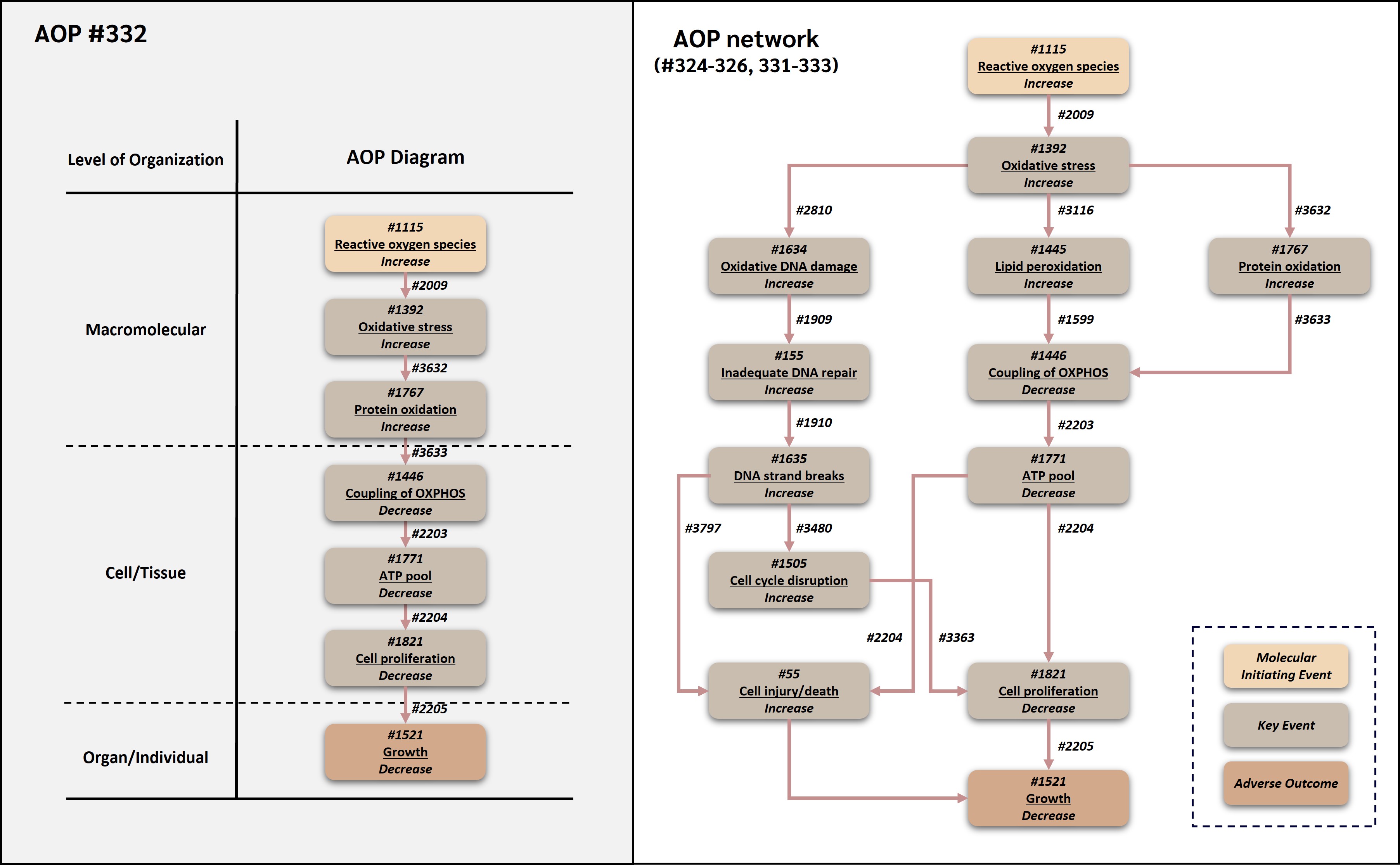
This adverse outcome pathway (AOP 332) describes a linear route by which increased reactive oxygen species (ROS) can lead to decreased organismal growth through oxidative stress-mediated protein oxidation and subsequent impairment of mitochondrial bioenergetics. Increased ROS is treated operationally as the molecular initiating event because it represents the earliest common measurable redox perturbation shared by diverse chemical and non-chemical stressors in the broader ROS-growth AOP network. Increased ROS leads to oxidative stress, which promotes oxidative modification of proteins. Oxidized proteins may lose catalytic, structural, transport, or regulatory function; they may also misfold, aggregate, or become targeted for degradation. When proteins required for mitochondrial electron transport, ATP synthase function, metabolite transport, or maintenance of mitochondrial membrane potential are oxidatively modified, coupling of oxidative phosphorylation (OXPHOS) can decrease. Reduced OXPHOS coupling decreases the cellular ATP pool, impairs ATP-dependent cell proliferation, and ultimately reduces growth.
AOP 332 reuses and connects established AOP-Wiki components from two major AOP contexts. The upstream ROS/oxidative stress module is associated with AOP 478, in which deposition of energy leads to oxidative stress through free radical generation and oxidative molecular damage (AOP-Wiki, 2026a). AOP 478 provides an AOP-Wiki precedent for oxidative stress as a conserved KE downstream of radical-generating stressors and for protein damage as an oxidative stress consequence. The downstream bioenergetic and growth module is directly associated with AOP 263, which causally links decreased coupling of OXPHOS to growth inhibition through ATP depletion and decreased cell proliferation (AOP-Wiki, 2026b; OECD, 2022; Song and Villeneuve, 2021). Thus, AOP 332 links an oxidative protein damage module to an OECD-endorsed OXPHOS-to-growth module. The AOP is relevant to environmental and human health contexts because ROS generation, protein oxidation, mitochondrial ATP production, cell proliferation, and organismal growth are broadly conserved in aerobic eukaryotes. Empirical support comes from studies in algae, fish, mollusks, mammalian systems, and human cells exposed to metals, hydrogen peroxide, hypoxia-reoxygenation, salinity or temperature stress, endogenous aging, and other oxidative stressors. This AOP can support mechanistic interpretation of oxidative stress-mediated growth impairment, assay selection, chemical prioritization, IATA development, and future quantitative AOP approaches for mitochondrial and oxidative stress-related toxicity.
Acknowledgement
This project was funded by the Research Council of Norway (RCN), grant no. RCN-315929 “EXPECT: In silico and experimental screening platform for characterizing environmental impact of industry development in the Arctic” (https://www.niva.no/en/projects/expect), the European Partnership for the Assessment of Risks from Chemicals (PARC) through European Union’s Horizon Europe research and innovation programme (Grant Agreement No 101057014, and supported by the NIVA Computational Toxicology Program, NCTP (https://www.niva.no/en/featured-pages/nctp, grant. No. RCN-342628).
AI disclosure
Artificial intelligence (AI) tools were used to support literature prioritization, review and AOP-Wiki page preparation in this work. AOP-helpFinder was used for automated literature mining, and ChatGPT (OpenAI) was used as an auxiliary tool for title and abstract screening, extraction of study metadata, and identification of potential weight-of-evidence indicators. AI-assisted outputs were used only to organize and prioritize information and were verified against the original sources by the authors before inclusion. Additional AI assistance was used for formatting, copy-editing, citation cross-checking, and harmonization of the AOP-Wiki pages. All scientific interpretations, weight-of-evidence judgments, final wording, and conclusions were determined and approved by the authors, who take full responsibility for the content and integrity of the work.
AOP Development Strategy
Context
ROS are continuously formed during aerobic metabolism and can also be generated in response to environmental stressors. At controlled levels, ROS participate in redox signaling, whereas excessive ROS can disturb redox homeostasis and initiate oxidative stress (Schieber and Chandel, 2014; Sies et al., 2017). Proteins are major targets of oxidative attack because many amino acid side chains and prosthetic groups are susceptible to oxidation, carbonylation, thiol oxidation, nitration, or other oxidative modifications. Protein oxidation can alter enzyme activity, protein-protein interactions, protein folding, stability, and degradation, and it is widely used as a marker of severe oxidative damage and cellular dysfunction (Dalle-Donne et al., 2006).
AOP 332 was developed to represent the protein oxidation-driven linear route within the broader ROS-growth AOP network. This route was selected because oxidative stress can directly modify proteins, including mitochondrial proteins involved in electron transport, OXPHOS coupling, ATP synthesis, metabolite transport, and maintenance of mitochondrial integrity. Oxidation of mitochondrial proteins can impair the efficiency of electron transfer and proton motive force utilization, thereby providing a mechanistically coherent bridge from oxidative stress to decreased coupling of OXPHOS (Murphy, 2009; Nicholls and Ferguson, 2013; Sokolov et al., 2019). The downstream sequence from decreased coupling of OXPHOS to decreased ATP pool, decreased cell proliferation, and decreased growth is represented in AOP 263 and provides the growth-relevant terminal module for AOP 332 (AOP-Wiki, 2026b; OECD, 2022; Song and Villeneuve, 2021).
Strategy
AOP 332 was developed using the principles described in OECD AOP guidance, including modular description of KEs and KERs, reuse of existing AOP-Wiki content where appropriate, evidence evaluation using biological plausibility, empirical support, essentiality, and quantitative understanding, and clear description of the biological domain of applicability (OECD, 2018, 2021). The objective was to assemble a focused linear pathway from reusable AOP-Wiki elements rather than to create an isolated de novo pathway. This is important because AOP 332 is one branch of the broader ROS-growth AOP network and because its downstream KEs and KERs overlap with the well-developed mitochondrial bioenergetics AOP 263.
Reuse of existing AOP-Wiki content was considered at the beginning of development. AOP 478 was reviewed because it provides an AOP-Wiki context for oxidative stress downstream of free radical generation and because it recognizes oxidative molecular damage, including protein damage, as a relevant consequence of oxidative stress. The KE increase in oxidative stress (Event 1392) and the conceptual linkage between radical generation, oxidative stress, and protein modification were therefore aligned with the AOP 478 context. AOP 263 was used as the primary source for the downstream module beginning with decreased coupling of OXPHOS (Event 1446), followed by decreased ATP pool (Event 1771), decreased cell proliferation (Event 1821), and decreased growth (Event 1521). The KERs decreased coupling of OXPHOS leading to decreased ATP pool, decreased ATP pool leading to decreased cell proliferation, and decreased cell proliferation leading to decreased growth were retained in the same causal order as AOP 263, supporting modular reuse and consistency with an OECD-endorsed pathway.
The literature review and evidence assembly process followed an AI-human hybrid workflow. First, event-specific search terms were developed for the KEs in AOP 332, including reactive oxygen species, oxidative stress, protein oxidation, protein carbonylation, oxidized proteins, mitochondrial protein oxidation, OXPHOS coupling, mitochondrial respiration, mitochondrial membrane potential, ATP depletion, cell proliferation, and growth. Synonyms, assay terms, representative stressors, taxa, and species names were also included. These terms were used in AOP-helpFinder to search PubMed for co-occurrence patterns between key events and mechanistic concepts, following text-mining approaches developed for AOP literature support (Carvaillo et al., 2019; Jornod et al., 2022). Exported records containing PMIDs, titles, abstracts, and matched terms were subjected to overlap analysis to remove redundant records and filter weakly relevant taxa- or endpoint-unrelated literature.
In the second phase, titles and abstracts from AOP-helpFinder and targeted manual searches were pre-screened using ChatGPT (GPT-4, OpenAI, San Francisco, CA, USA) as an auxiliary prioritization tool. The LLM was used to extract study metadata, including stressor, species, biological system, dose or concentration, and exposure duration; to identify evidence type, including biological plausibility, empirical support, and essentiality; and to flag weight-of-evidence indicators such as dose-response concordance, temporal concordance, incidence concordance, and intervention or rescue evidence. Studies were classified as high, medium, or low relevance. High-relevance studies were retrieved for full-text review, medium-relevance studies were reserved as supporting evidence, and low-relevance studies were documented as low priority or excluded. For full texts, LLM-assisted review was used only to organize candidate information; all outputs were verified against the original articles by human experts.
The final phase consisted of manual expert curation and weight-of-evidence evaluation. Experts verified relevance and interpretation of selected studies, extracted data into KER evidence tables, and evaluated biological plausibility, empirical support, essentiality, quantitative understanding, inconsistencies, and modulating factors. Targeted searches were also performed to fill evidence gaps for protein oxidation and mitochondrial dysfunction. Studies were prioritized when they measured two or more KEs in the same system, reported exposure duration and dose or concentration, or provided evidence relevant to concordance across the pathway. Mechanistic reviews and OECD reports were used to support well-established biological plausibility, whereas primary experimental studies were prioritized for empirical support (Dalle-Donne et al., 2006; Canesi et al., 2010; Almaida-Pagán et al., 2014; Sokolov et al., 2019; Song and Villeneuve, 2021; OECD, 2022).
Summary of the AOP
Events:
Molecular Initiating Events (MIE)
Key Events (KE)
Adverse Outcomes (AO)
| Type | Event ID | Title | Short name |
|---|
| MIE | 1115 | Increase, Reactive oxygen species | Increase, ROS |
| KE | 1392 | Increase, Oxidative Stress | Increase, Oxidative Stress |
| KE | 1767 | Increase, Protein oxidation | Increase, Protein oxidation |
| KE | 1446 | Decrease, Coupling of oxidative phosphorylation | Decrease, Coupling of OXPHOS |
| KE | 1771 | Decrease, Adenosine triphosphate pool | Decrease, ATP pool |
| KE | 1821 | Decrease, Cell proliferation | Decrease, Cell proliferation |
| AO | 1521 | Decrease, Growth | Decrease, Growth |
Relationships Between Two Key Events (Including MIEs and AOs)
| Title | Adjacency | Evidence | Quantitative Understanding |
|---|
| Increase, ROS leads to Increase, Oxidative Stress | adjacent | High | Moderate |
| Increase, Oxidative Stress leads to Increase, Protein oxidation | adjacent | High | Moderate |
| Increase, Protein oxidation leads to Decrease, Coupling of OXPHOS | adjacent | Moderate | Low |
| Decrease, Coupling of OXPHOS leads to Decrease, ATP pool | adjacent | High | High |
| Decrease, ATP pool leads to Decrease, Cell proliferation | adjacent | High | Moderate |
| Decrease, Cell proliferation leads to Decrease, Growth | adjacent | High | Moderate |
Network View
Prototypical Stressors
Life Stage Applicability
| Life stage | Evidence |
|---|---|
| All life stages | Moderate |
Taxonomic Applicability
Sex Applicability
| Sex | Evidence |
|---|---|
| Unspecific | Moderate |
Overall Assessment of the AOP
The overall weight of evidence supporting AOP 332 is considered moderate. Biological plausibility is high for all six KERs in the pathway. The chemical reactivity of ROS with proteins is well established, and the functional consequences of oxidative modification of mitochondrial respiratory proteins for OXPHOS coupling are mechanistically well supported. The downstream module from decreased OXPHOS coupling through ATP depletion, reduced cell proliferation, and decreased growth is directly reused from OECD-endorsed AOP 263, contributing high biological plausibility and established quantitative relationships for this segment (OECD, 2022; Song and Villeneuve, 2021). Empirical support is high for the upstream ROS-to-oxidative-stress and oxidative-stress-to-protein-oxidation relationships, where multiple stressors across algae, fish, mollusks, and mammalian systems demonstrate concordant increases in oxidative stress markers and protein carbonylation or oxidized protein products. Empirical support for the protein oxidation-to-OXPHOS coupling transition (KER 3633) is rated moderate, as evidence from aging, hypoxia-reoxygenation, and metal exposure studies links oxidative mitochondrial proteome changes to altered bioenergetics, but controlled intervention experiments specifically targeting protein oxidation without confounding other oxidative damage processes are limited. Essentiality is rated moderate to high overall, with the strongest direct support for the AOP 263 OXPHOS and ATP segment. Quantitative understanding is highest for the AOP 263-derived downstream module and low to moderate for the protein oxidation-to-OXPHOS transition, where generalizable cross-taxa quantitative models are lacking. The main uncertainties are the causal versus correlational nature of the protein oxidation-OXPHOS relationship, given that lipid peroxidation and other oxidative processes often co-occur, and the variable capacity of proteasomal and chaperone systems to mitigate protein oxidation-related mitochondrial dysfunction. AOP 332 is most suitable for mechanistic interpretation and chemical prioritisation for oxidative stress-related growth impairment (OECD, 2018; Becker et al., 2015).
Domain of Applicability
The domain of applicability for AOP 332 is broad across aerobic eukaryotic organisms in which ROS generation, oxidative stress responses, protein oxidation, mitochondrial oxidative phosphorylation, ATP-dependent cell proliferation, and growth are biologically relevant. The AOP is most directly applicable to organisms or life stages in which growth depends substantially on mitochondrial ATP supply and cell proliferation. It is also applicable to cellular systems used to evaluate oxidative stress, mitochondrial dysfunction, ATP depletion, and proliferation outcomes.
The stressor domain includes direct oxidants, redox-cycling chemicals, metals, radiation, hypoxia-reoxygenation, temperature or salinity stress, and endogenous oxidative stress. Because the MIE is defined operationally as increased ROS rather than as a chemical-specific interaction, AOP 332 should be applied when evidence demonstrates increased ROS or oxidative stress and when downstream evidence supports protein oxidation and mitochondrial bioenergetic impairment. Important modifiers include antioxidant capacity, protein repair and degradation capacity, mitochondrial reserve capacity, temperature, oxygen availability, nutrient status, species metabolic rate, and growth stage.
Essentiality of the Key Events
Essentiality is evaluated for the overall AOP based on whether preventing or modifying upstream KEs changes downstream KEs or the AO. The strongest direct essentiality evidence is available for the downstream AOP 263 module, where restoring mitochondrial coupling or ATP production can recover downstream bioenergetic and proliferative functions. Essentiality for protein oxidation is mechanistically plausible and supported by intervention and association evidence, but direct experiments showing that selective prevention of protein oxidation blocks all downstream events remain limited.
|
Key event |
Essentiality |
Rationale |
Experimental manipulation evidence (KE knock-out / inhibition / rescue) |
Uncertainties |
|
Event 1115: Reactive oxygen species, increased |
Moderate |
ROS scavenging and antioxidant interventions often attenuate oxidative stress and protein oxidation in oxidative stress models (Schieber and Chandel, 2014; Sies et al., 2017). |
Indirect (stop/attenuation): antioxidant and ROS-scavenger pre-treatment reduces oxidative stress and downstream damage across oxidative-stress models (Schieber and Chandel, 2014; Sies et al., 2017). No selective single-source ROS knock-out is available. |
ROS also serve physiological signaling roles; increased ROS may not progress if antioxidant systems compensate. |
|
Event 1392: Oxidative stress, increased |
Moderate to high |
Oxidative stress is required for widespread oxidative protein modification when oxidant production exceeds antioxidant and repair capacity. AOP 478 supports oxidative stress as a central KE downstream of radical generation (AOP-Wiki, 2026a). |
Indirect: modulation of antioxidant capacity alters progression to oxidative macromolecular damage; oxidative stress is the curated hub KE in endorsed AOP 478 (AOP-Wiki, 2026a; Carrothers et al., 2025). |
Different oxidative stress biomarkers may capture different aspects of redox imbalance. |
|
Event 1767: Protein oxidation, increased |
Moderate |
Protein carbonylation and related oxidative modifications can impair enzyme activity, protein folding, degradation, and mitochondrial function (Dalle-Donne et al., 2006). Cadmium-induced protein carbonylation and actin glutathionylation in mussel hemocytes were reduced by oxidase/NOS inhibitors, supporting causal involvement of oxidative signaling (Canesi et al., 2010). |
Direct (partial): cadmium-induced protein carbonylation and actin glutathionylation reduced by oxidase/NOS inhibitors in mussel hemocytes (Canesi et al., 2010); GSTA4 silencing raised mitochondrial protein carbonylation and target knockdown reduced respiration (Curtis et al., 2012). |
Protein oxidation can be cause, consequence, or marker of cellular stress; selective intervention evidence is limited. |
|
Event 1446: Coupling of OXPHOS, decreased |
High |
This KE is reused from AOP 263. Evidence from AOP 263 supports essentiality because uncoupler removal or restoration of mitochondrial coupling can recover mitochondrial membrane potential and ATP levels (AOP-Wiki, 2026b; OECD, 2022; Song and Villeneuve, 2021). |
Direct (rescue): removal of uncouplers or restoration of coupling recovers mitochondrial membrane potential and ATP in the endorsed AOP 263 module (AOP-Wiki, 2026b; OECD, 2022; Song and Villeneuve, 2021). |
Mild uncoupling can be adaptive and may reduce ROS generation depending on context. |
|
Event 1771: ATP pool, decreased |
Moderate |
ATP depletion is associated with reduced proliferation and cytotoxicity in multiple systems and is a central KE in AOP 263 (AOP-Wiki, 2026b; OECD, 2022). |
Indirect: ATP-restoration experiments reduce downstream injury/proliferation deficits; central KE in endorsed AOP 263 (Leist et al., 1997; Nicotera et al., 1998; OECD, 2022). |
Cells may compensate via glycolysis or altered energy allocation. |
|
Event 1821: Cell proliferation, decreased |
Moderate |
Growth is dependent on cell number and biomass accumulation; AOP 263 supports decreased cell proliferation as a direct link between bioenergetic impairment and growth reduction (AOP-Wiki, 2026b; Conlon and Raff, 1999; OECD, 2022). |
Indirect: proliferation deficit links bioenergetic/genotoxic upstream to growth; reused from endorsed AOP 263 with KER 2205 (AOP-Wiki, 2026d; Conlon and Raff, 1999; OECD, 2022; Song and Villeneuve, 2021). |
Growth can also be influenced by cell size, nutrient status, development, and cell death. |
|
Event 1521: Growth, decreased (AO) |
Not applicable (AO) |
Growth is the adverse outcome and a regulatory-relevant endpoint across several OECD and ISO test systems; AOP 263 provides precedent for decreased growth as an AO downstream of mitochondrial bioenergetic impairment (OECD, 2022; Song and Villeneuve, 2021). |
As the adverse outcome, essentiality is assessed for upstream KEs; AOP 263 provides precedent for decreased growth as an AO downstream of these modules (OECD, 2022; Song and Villeneuve, 2021). |
Growth is integrative and can arise through multiple mechanisms. |
Evidence Assessment
Evidence assessment is organized by KER. Calls follow OECD weight-of-evidence considerations for biological plausibility, empirical support, and quantitative understanding (OECD, 2018, 2021).
Biological plausibility of KERs
|
KER |
Biological plausibility call |
Rationale |
|
Relationship 2009: ROS increase leads to oxidative stress increase |
High |
Oxidative stress reflects an imbalance between oxidants and antioxidant defenses; ROS are major cellular oxidants and primary drivers of redox imbalance (Schieber and Chandel, 2014; Sies et al., 2017). AOP 478 provides a curated context for oxidative stress downstream of radical generation (AOP-Wiki, 2026a). |
|
Relationship 3632: oxidative stress increase leads to protein oxidation increase |
High |
ROS and related oxidants can modify protein side chains, thiols, metal centers, and prosthetic groups, producing carbonylated, glutathionylated, misfolded, or aggregated proteins (Dalle-Donne et al., 2006; Sies et al., 2017). |
|
Relationship 3633: protein oxidation increase leads to decreased coupling of OXPHOS |
Moderate to high |
Mitochondrial OXPHOS depends on the integrity of electron transport complexes, ATP synthase, carrier proteins, and membrane-associated protein assemblies. Oxidative modification of these proteins can impair electron transfer, proton pumping, membrane potential, and ATP synthesis efficiency (Murphy, 2009; Nicholls and Ferguson, 2013; Sokolov et al., 2019). |
|
Relationship 2203: decreased coupling of OXPHOS leads to decreased ATP pool |
High |
This relationship is reused from AOP 263. OXPHOS coupling is a major determinant of ATP production in aerobic eukaryotic cells; reduced coupling lowers ATP synthesis efficiency (AOP-Wiki, 2026b; OECD, 2022; Song and Villeneuve, 2021). |
|
Relationship 2204: decreased ATP pool leads to decreased cell proliferation |
High |
This relationship is reused from AOP 263. Cell proliferation requires ATP for DNA replication, mitosis, biosynthesis, and maintenance of cellular processes; ATP depletion therefore plausibly reduces proliferation (AOP-Wiki, 2026b; Bonora et al., 2012; OECD, 2022). |
|
Relationship 2205: decreased cell proliferation leads to decreased growth |
High |
This relationship is reused from AOP 263. Organismal, tissue, and population growth require accumulation of cells and biomass; sustained reduction in proliferation is therefore expected to reduce growth (AOP-Wiki, 2026b; Conlon and Raff, 1999; OECD, 2022). |
Empirical support for KERs
|
KER |
Empirical support call |
Rationale |
Inconsistencies or evidence gaps |
|
Relationship 2009: ROS increase leads to oxidative stress increase |
High |
Multiple studies demonstrate concordance between ROS-producing stressors and oxidative stress biomarkers. Paraquat increased ROS and antioxidant enzyme responses in Chlorella vulgaris (Qian et al., 2009). In fish, infection-induced ROS coincided with antioxidant and inflammatory responses (Gao et al., 2022). |
ROS is often transient and indirectly measured; oxidative stress endpoints differ across studies. |
|
Relationship 3632: oxidative stress increase leads to protein oxidation increase |
High |
Oxidative stressors increase protein carbonyls or related protein oxidation endpoints. Cadmium and hydrogen peroxide increased protein carbonylation and redox modification in Chlamydomonas systems (Zaffagnini et al., 2012). Cadmium induced protein carbonylation and actin glutathionylation in mussel hemocytes (Canesi et al., 2010). Thermal stress in zebrafish increased protein carbonyls with antioxidant responses (Tseng et al., 2011). |
Protein oxidation endpoints are heterogeneous; some studies measure total carbonyls whereas others identify specific oxidized proteins. |
|
Relationship 3633: protein oxidation increase leads to decreased coupling of OXPHOS |
Moderate |
Evidence links oxidative protein damage or mitochondrial proteome modification with altered mitochondrial function. Age-associated oxidative changes in zebrafish were associated with changes in mitochondrial oxidative status and aconitase activity (Almaida-Pagán et al., 2014). Hypoxia-reoxygenation altered mitochondrial proteome and bioenergetics in Crassostrea gigas (Sokolov et al., 2019). |
Many studies measure correlation rather than direct causation; protein oxidation may occur alongside lipid peroxidation or other mitochondrial damage. |
|
Relationship 2203: decreased coupling of OXPHOS leads to decreased ATP pool |
High |
This relationship is supported by AOP 263 and by multiple studies of mitochondrial uncouplers and mitochondrial toxicants showing ATP depletion following reduced OXPHOS efficiency (AOP-Wiki, 2026b; OECD, 2022; Song and Villeneuve, 2021). |
Cells may transiently compensate through glycolysis or substrate switching. |
|
Relationship 2204: decreased ATP pool leads to decreased cell proliferation |
Moderate to high |
AOP 263 reports concordance between ATP depletion and decreased cell proliferation across biological systems. ATP content is widely used as a quantitative indicator of cell viability and proliferative capacity (AOP-Wiki, 2026b; Bonora et al., 2012; OECD, 2022). |
ATP depletion may lead to either proliferation arrest or cell death depending on severity and duration. |
|
Relationship 2205: decreased cell proliferation leads to decreased growth |
Moderate |
AOP 263 provides empirical support for this relationship and identifies growth as a biologically and regulatory relevant endpoint downstream of reduced cell proliferation (AOP-Wiki, 2026b; OECD, 2022; Song and Villeneuve, 2021). |
Growth integrates many processes, and direct measurement of proliferation and organismal growth in the same study is less common. |
Inconsistencies and uncertainties
The main uncertainty in AOP 332 is the causal versus correlational nature of the protein oxidation to decreased OXPHOS coupling relationship (KER 3633), because lipid peroxidation and other oxidative processes frequently co-occur and can independently impair mitochondrial function. Controlled intervention experiments that target protein oxidation without confounding other oxidative damage are limited, and the capacity of proteasomal and chaperone systems to mitigate protein-oxidation-related mitochondrial dysfunction varies across taxa and exposure conditions. As with the other AOPs in this network, ROS-mediated growth inhibition can also proceed through genotoxic, lipid peroxidation, and cell death branches, so the protein oxidation branch represented here captures only one mechanistic route. Finally, growth is a multifactorial apical endpoint, which limits quantitative prediction of organismal growth from upstream protein oxidation and bioenergetic events.
Known Modulating Factors
|
Modulating factor |
Influence or outcome |
KER(s) involved |
|
Antioxidant capacity |
Higher antioxidant capacity can reduce oxidative stress and protein oxidation; low capacity can increase progression. |
2009, 3632 |
|
Protein repair/degradation capacity |
Proteasomal and chaperone systems influence whether oxidized proteins are removed, refolded, or accumulate. |
3632, 3633 |
|
Mitochondrial reserve capacity |
High reserve capacity may buffer the effect of oxidized mitochondrial proteins on ATP output. |
3633, 2203 |
|
Temperature and oxygen availability |
Modify ROS production, mitochondrial activity, and oxidative protein damage, especially in aquatic ectotherms. |
2009, 3632, 3633 |
|
Life stage and growth rate |
Rapidly growing systems may be more sensitive to ATP depletion and reduced proliferation. |
2204, 2205 |
|
Nutritional and metabolic state |
Affects antioxidant defenses, substrate availability, glycolytic compensation, and growth. |
Multiple |
Quantitative Understanding
Quantitative understanding of AOP 332 is strongest for the downstream AOP 263 module and more limited for the protein oxidation to OXPHOS transition. Protein oxidation is measurable using protein carbonyl assays, redox proteomics, and targeted detection of oxidized mitochondrial proteins, but translation from the extent of protein oxidation to a quantitative decrement in OXPHOS coupling remains context-dependent.
|
KER |
Quantitative understanding call |
Rationale |
|
Relationship 2009: ROS increase leads to oxidative stress increase |
Low to moderate |
ROS and oxidative stress biomarkers can be quantified, but ROS are short-lived and measurement is assay-dependent (Sies et al., 2017). |
|
Relationship 3632: oxidative stress increase leads to protein oxidation increase |
Moderate |
Protein carbonyls and redox proteomics provide quantitative measures of protein oxidation, but response-response models linking oxidative stress magnitude to protein oxidation are not broadly generalizable (Dalle-Donne et al., 2006). |
|
Relationship 3633: protein oxidation increase leads to decreased coupling of OXPHOS |
Low to moderate |
Specific oxidation of mitochondrial proteins can be linked to altered mitochondrial function in some systems, but predictive quantitative models are not yet established across taxa or stressors (Sokolov et al., 2019). |
|
Relationship 2203: decreased coupling of OXPHOS leads to decreased ATP pool |
High |
AOP 263 includes quantitative understanding for OXPHOS coupling and ATP depletion, supported by bioenergetic theory and experimental response-response relationships (AOP-Wiki, 2026b; OECD, 2022; Song and Villeneuve, 2021). |
|
Relationship 2204: decreased ATP pool leads to decreased cell proliferation |
Moderate |
ATP is often used as a quantitative indicator of cell status and proliferation, but thresholds vary by cell type and stress duration (Bonora et al., 2012; OECD, 2022). |
|
Relationship 2205: decreased cell proliferation leads to decreased growth |
Moderate |
Quantitative relationships between proliferation and growth exist in developmental and tissue growth biology, but stressor-specific models for this AOP remain limited (Conlon and Raff, 1999; OECD, 2022). |
BMD/POD-anchored concordance
The following benchmark-dose/point-of-departure (BMD/POD) concordance table anchors AOP 332 to quantitative cross-KE ordering, in line with Handbook section 4C. The multiomics point-of-departure (moPOD) dataset for gamma-irradiated Daphnia magna (Song et al., 2023) provides POD magnitudes for increased ROS, decreased ATP, decreased OXPHOS coupling, and cell death, demonstrating the expected upstream-to-downstream POD ordering (more sensitive PODs upstream). The moPOD is presented as POD magnitude evidence, not as a causal re-ordering of KEs. The Lemna minor EDR50 range provides a whole-pathway apical anchor in an aquatic primary producer.
|
Key event (functional category) |
POD metric |
POD value (mGy/h) |
POD ordering |
Source |
|
KE 1115: ROS, increased (mROS) |
moPOD (multiomics POD) |
0.4 |
1 (most sensitive) |
Song et al., 2023 |
|
KE 1771: ATP pool, decreased |
moPOD |
2.5 |
2 |
Song et al., 2023 |
|
KE 1446: OXPHOS coupling, decreased (UPS/OXPHOS module) |
moPOD |
42.3 |
3 |
Song et al., 2023 |
|
KE 55: Cell injury/death (apoptosis) |
moPOD |
42.3 |
3 (least sensitive) |
Song et al., 2023 |
|
Upstream KE chain → growth (Lemna minor, gamma) |
EDR50 (growth) |
31.5–54.8 (mGy/h) |
whole-pathway apical |
Xie et al., 2018, 2019, 2022 |
Considerations for Potential Applications of the AOP (optional)
AOP 332 can support mechanistic interpretation of growth impairment caused by oxidative stressors that produce protein oxidation and mitochondrial bioenergetic dysfunction. It is particularly useful for organizing evidence from assays measuring protein carbonyls, redox proteomics, mitochondrial respiration, mitochondrial membrane potential, ATP content, cell proliferation, and organismal growth. Because the downstream module is shared with AOP 263, the AOP can contribute to IATA and NAM-based screening strategies that use mitochondrial function, ATP status, and proliferation as early warning indicators for growth effects.
The AOP may also support chemical prioritization and grouping for stressors that induce ROS generation or oxidative stress and that show evidence for protein oxidation or mitochondrial impairment. Potential stressor classes include metals, redox-active organic chemicals, radiation, hypoxia-reoxygenation, and other environmental conditions that increase oxidative protein damage. The AOP should not be used as a stand-alone quantitative predictor of growth inhibition without additional empirical support, because the protein oxidation to OXPHOS transition remains less quantitatively resolved than the downstream AOP 263 module.
References
Almaida-Pagán, P.F., Lucas-Sánchez, A., & Tocher, D.R. (2014). Changes in mitochondrial membrane composition and oxidative status during rapid growth, maturation and aging in zebrafish, Danio rerio. Biochimica et Biophysica Acta - Molecular and Cell Biology of Lipids, 1841(7), 1003-1011. https://doi.org/10.1016/j.bbalip.2014.04.004
AOP-Wiki. (2026a). AOP 478: Deposition of energy leading to occurrence of cataracts. Adverse Outcome Pathway Wiki. https://aopwiki.org/aops/478
AOP-Wiki. (2026b). AOP 263: Uncoupling of oxidative phosphorylation leading to growth inhibition via decreased cell proliferation. Adverse Outcome Pathway Wiki. https://aopwiki.org/aops/263
Ayala, A., Munoz, M.F., & Arguelles, S. (2014). Lipid peroxidation: Production, metabolism, and signaling mechanisms of malondialdehyde and 4-hydroxy-2-nonenal. Oxidative Medicine and Cellular Longevity, 2014, 360438. https://doi.org/10.1155/2014/360438
Barata, C., Varo, I., Navarro, J.C., Arun, S., & Porte, C. (2005). Antioxidant enzyme activities and lipid peroxidation in the freshwater cladoceran Daphnia magna exposed to redox cycling compounds. Comparative Biochemistry and Physiology Part C: Toxicology & Pharmacology, 140(2), 175-186. https://doi.org/10.1016/j.cca.2005.01.013
Bonora, M., Patergnani, S., Rimessi, A., De Marchi, E., Suski, J.M., Bononi, A., Giorgi, C., Marchi, S., Missiroli, S., Poletti, F., Wieckowski, M.R., & Pinton, P. (2012). ATP synthesis and storage. Purinergic Signaling, 8(3), 343-357. https://doi.org/10.1007/s11302-012-9305-8
Canesi, L., Ciacci, C., Betti, M., Lorusso, L.C., Marchi, B., Burattini, S., Falcieri, E., & Gallo, G. (2010). The role of signaling molecules on actin glutathionylation and protein carbonylation induced by cadmium in hemocytes of mussel Mytilus galloprovincialis. Journal of Experimental Biology, 213(3), 361-372. https://doi.org/10.1242/jeb.035550
Carvaillo, J.C., Barouki, R., Coumoul, X., & Audouze, K. (2019). Linking bisphenol S to adverse outcome pathways using a combined text mining and systems biology approach. Environmental Health Perspectives, 127(4), 047005. https://doi.org/10.1289/EHP4200
Conlon, I., & Raff, M. (1999). Size control in animal development. Cell, 96(2), 235-244. https://doi.org/10.1016/S0092-8674(00)80563-2
Curtis, J. M., Hahn, W. S., Stone, M. D., Inda, J. J., Droullard, D. J., Kuzmicic, J. P., Donoghue, M. A., Long, E. K., Armien, A. G., Lavandero, S., Arriaga, E., Griffin, T. J., & Bernlohr, D. A. (2012). Protein carbonylation and adipocyte mitochondrial function. Journal of Biological Chemistry, 287(39), 32967-32980. https://doi.org/10.1074/jbc.M112.400663
Dalle-Donne, I., Aldini, G., Carini, M., Colombo, R., Rossi, R., & Milzani, A. (2006). Protein carbonylation, cellular dysfunction, and disease progression. Journal of Cellular and Molecular Medicine, 10(2), 389-406. https://doi.org/10.1111/j.1582-4934.2006.tb00407.x
Gao, J., Liu, M., Guo, H., Zhu, K., Liu, B., Liu, B., & Zhang, D. (2022). ROS induced by Streptococcus agalactiae activate inflammatory responses via the TNF-alpha/NF-kappaB signaling pathway in golden pompano Trachinotus ovatus (Linnaeus, 1758). Antioxidants, 11(9), 1809. https://doi.org/10.3390/antiox11091809
Jornod, F., Jaylet, T., Blaha, L., Sarigiannis, D., Tamisier, L., & Audouze, K. (2022). AOP-helpFinder webserver: A tool for comprehensive analysis of the literature to support adverse outcome pathways development. Bioinformatics, 38(4), 1173-1175. https://doi.org/10.1093/bioinformatics/btab750
Murphy, M.P. (2009). How mitochondria produce reactive oxygen species. Biochemical Journal, 417(1), 1-13. https://doi.org/10.1042/BJ20081386
Nicholls, D.G., & Ferguson, S.J. (2013). Bioenergetics 4. Academic Press.
Nicotera, P., Leist, M., & Ferrando-May, E. (1998). Intracellular ATP, a switch in the decision between apoptosis and necrosis. Toxicology Letters, 102-103, 139-142. https://doi.org/10.1016/S0378-4274(98)00298-7
OECD. (2018). Users' handbook supplement to the guidance document for developing and assessing adverse outcome pathways. OECD Series on Adverse Outcome Pathways No. 1. OECD Publishing.
OECD. (2021). Guidance document for the scientific review of adverse outcome pathways. OECD Series on Testing and Assessment No. 344. OECD Publishing.
OECD. (2022). Uncoupling of oxidative phosphorylation leading to growth inhibition via decreased cell proliferation. OECD Series on Adverse Outcome Pathways No. 28. OECD Publishing. https://doi.org/10.1787/f20867c1-en
Qian, H., Chen, W., Sun, L., Jin, Y., Liu, W., & Fu, Z. (2009). Inhibitory effects of paraquat on photosynthesis and the response to oxidative stress in Chlorella vulgaris. Ecotoxicology, 18(5), 537-543. https://doi.org/10.1007/s10646-009-0311-8
Schieber, M., & Chandel, N.S. (2014). ROS function in redox signaling and oxidative stress. Current Biology, 24(10), R453-R462. https://doi.org/10.1016/j.cub.2014.03.034
Sies, H., Berndt, C., & Jones, D.P. (2017). Oxidative stress. Annual Review of Biochemistry, 86, 715-748. https://doi.org/10.1146/annurev-biochem-061516-045037
Sokolov, E.P., Markert, S., Hinzke, T., Hirschfeld, C., Becher, D., Ponsuksili, S., & Sokolova, I.M. (2019). Effects of hypoxia-reoxygenation stress on mitochondrial proteome and bioenergetics of the hypoxia-tolerant marine bivalve Crassostrea gigas. Journal of Proteomics, 194, 99-111. https://doi.org/10.1016/j.jprot.2018.12.009
Song, Y., & Villeneuve, D.L. (2021). AOP report: Uncoupling of oxidative phosphorylation leading to growth inhibition via decreased cell proliferation. Environmental Toxicology and Chemistry, 40(11), 2951-2963. https://doi.org/10.1002/etc.5197
Tseng, Y.C., Chen, R.D., Lucassen, M., Schmidt, M.M., Dringen, R., Abele, D., & Hwang, P.P. (2011). Exploring uncoupling proteins and antioxidant mechanisms under acute cold exposure in brains of fish. PLoS ONE, 6(3), e18180. https://doi.org/10.1371/journal.pone.0018180
Zaffagnini, M., Bedhomme, M., Groni, H., Marchand, C.H., Puppo, C., Gontero, B., Cassier-Chauvat, C., Decottignies, P., & Lemaire, S.D. (2012). Glutathionylation in the photosynthetic model organism Chlamydomonas reinhardtii: A proteomic survey. Molecular & Cellular Proteomics, 11(8), M111.014142. https://doi.org/10.1074/mcp.M111.014142